
Beautiful Plants For Your Interior
Beautiful Plants For Your Interior
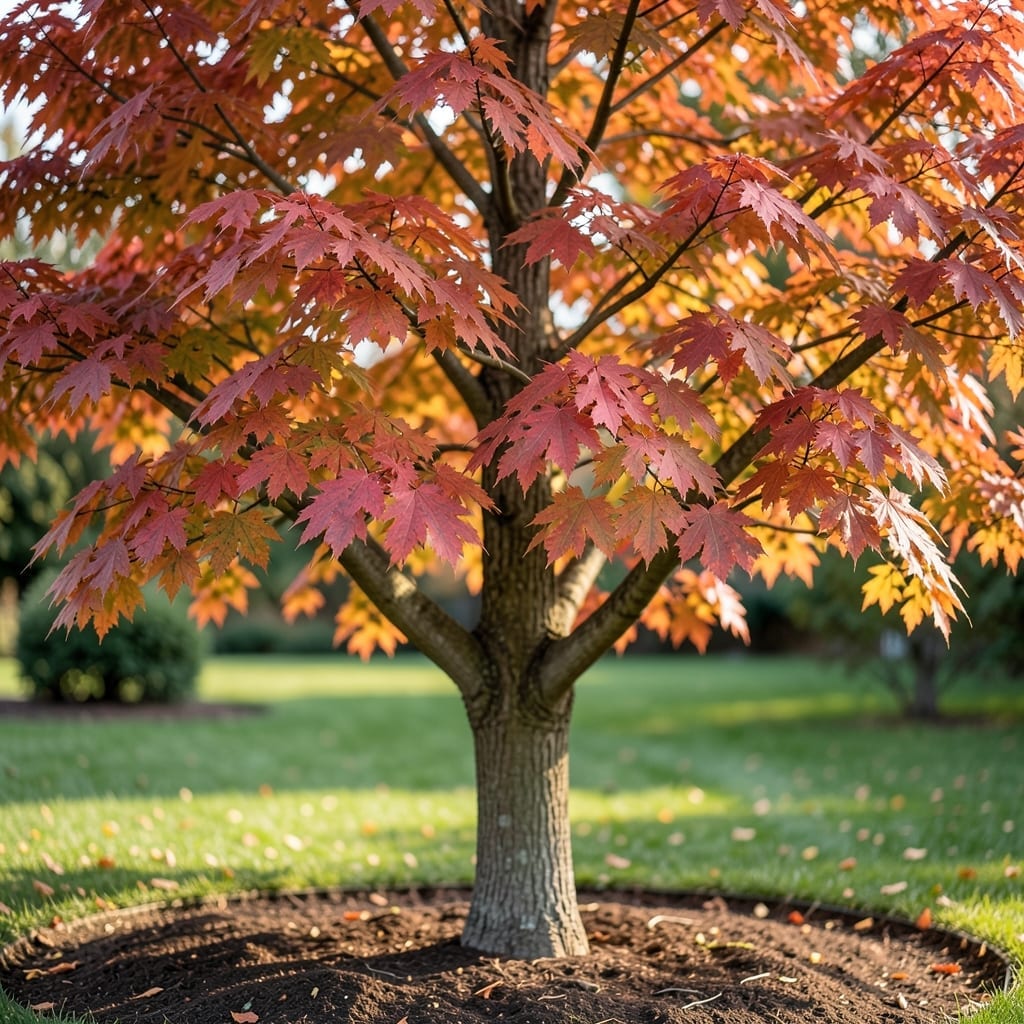
I used to struggle telling maple species apart until I started studying the leaves. The shape, edges, and lobes tell you everything you need to know about what kind of maple you’re looking at.
Once you learn these patterns, you can spot sugar maples from red maples in seconds. The key is noticing subtle differences most people miss—like how deeply the leaves are divided or the exact color of their undersides.
📚 In This Guide
Here’s the straightforward method I use to tell maple species apart by their leaves alone.
Start by counting the main lobes on a single leaf. Sugar maples typically have 5 distinct lobes with deep, rounded notches between them. Red maples often show 3-5 lobes with more pointed tips and jagged edges.
Silver maples are easier to spot—their leaves have 5 deeply cut lobes that look almost like a hand with splayed fingers. The space between lobes is often wider than the lobes themselves, which is a dead giveaway.
Run your finger along the edge of the leaf to feel the texture. Sugar maples have smooth, almost wavy margins between lobes. Red maples, on the other hand, display serrated edges that feel slightly rough to the touch.
Norway maples often have a single large tooth at the base of each lobe, while Japanese maples show finely serrated edges that look almost lace-like. These small details make identification much more precise.
Look closely at where the leaf meets the stem. Sugar maples have a U-shaped base, while red maples often show a more V-shaped or heart-shaped base. This subtle difference is easier to spot when you hold the leaf up to the light.
Boxelder maples are the exception—they have compound leaves with 3-5 leaflets growing from a single stem. If you see this structure, you’ve found a boxelder, which is technically a maple but looks completely different.
Color provides another layer of identification. Sugar maples turn a brilliant orange-red in fall, while red maples shift to a bright scarlet. Silver maples often show a silvery underside to their leaves, which is visible when the wind flips them over.
In spring, new growth on red maples often has a reddish tint, while sugar maples emerge a lighter green. These color variations help confirm your identification, especially when combined with the lobe and edge characteristics.
Measure the leaf from base to tip. Sugar maples typically have leaves 3-5 inches long, while bigleaf maples can reach 6-12 inches across. Silver maples fall in the middle, usually around 3-6 inches.
Also consider the overall shape. Japanese maples have a delicate, almost fern-like appearance, while bigleaf maples look broad and substantial. The size and shape together create a clear picture of which maple species you’re observing.
These practical pointers will help you identify maple species with accuracy and confidence.
The Shape Factor: In Step 1, pay close attention to the number of lobes and their edges. Sugar maples always have exactly 5 distinct lobes, while red maples can have 3-5 with those telltale jagged edges. I learned this the hard way after misidentifying several leaves early on.
Size Matters: Step 2 mentions specific size ranges for good reason. Sugar maple leaves are consistently 3-6 inches wide, so if you’re seeing something smaller, it’s likely a red or Japanese maple. Always measure across the widest part of the leaf for accuracy.
Seasonal Clues: Step 4 reveals how fall colors can be your best identification tool. Sugar maples turn that spectacular orange-red combo, while red maples go for a more uniform red. This is when the differences are most obvious, so if you’re unsure, wait for autumn to make your final determination.
Documentation Tip: As mentioned in Step 5, taking photos in natural light is invaluable. I recommend photographing both sides of the leaf and including something for scale, like a coin or ruler, to help with later identification.
Maple leaves change color due to chemical changes as chlorophyll breaks down, revealing hidden pigments like carotenoids (orange) and anthocyanins (red). Cooler temperatures and shorter days trigger this vibrant transformation.
Look for spots, discoloration, or unusual patterns. Common signs include black tar-like spots (tar spot fungus), yellowing (chlorosis), or brown edges (leaf scorch). Early diagnosis helps prevent spread.
Prune in late winter or early spring before new growth starts. Avoid pruning in fall, as it can encourage new growth vulnerable to frost damage.
Consider sweetgum, red oak, or serviceberry trees for colorful fall foliage. These alternatives offer vibrant leaves and adapt well to various climates.
Curling or wilting leaves may indicate underwatering, overwatering, or pests like aphids. Check soil moisture and inspect leaves for pests or disease to address the issue.