
Beautiful Plants For Your Interior
Beautiful Plants For Your Interior
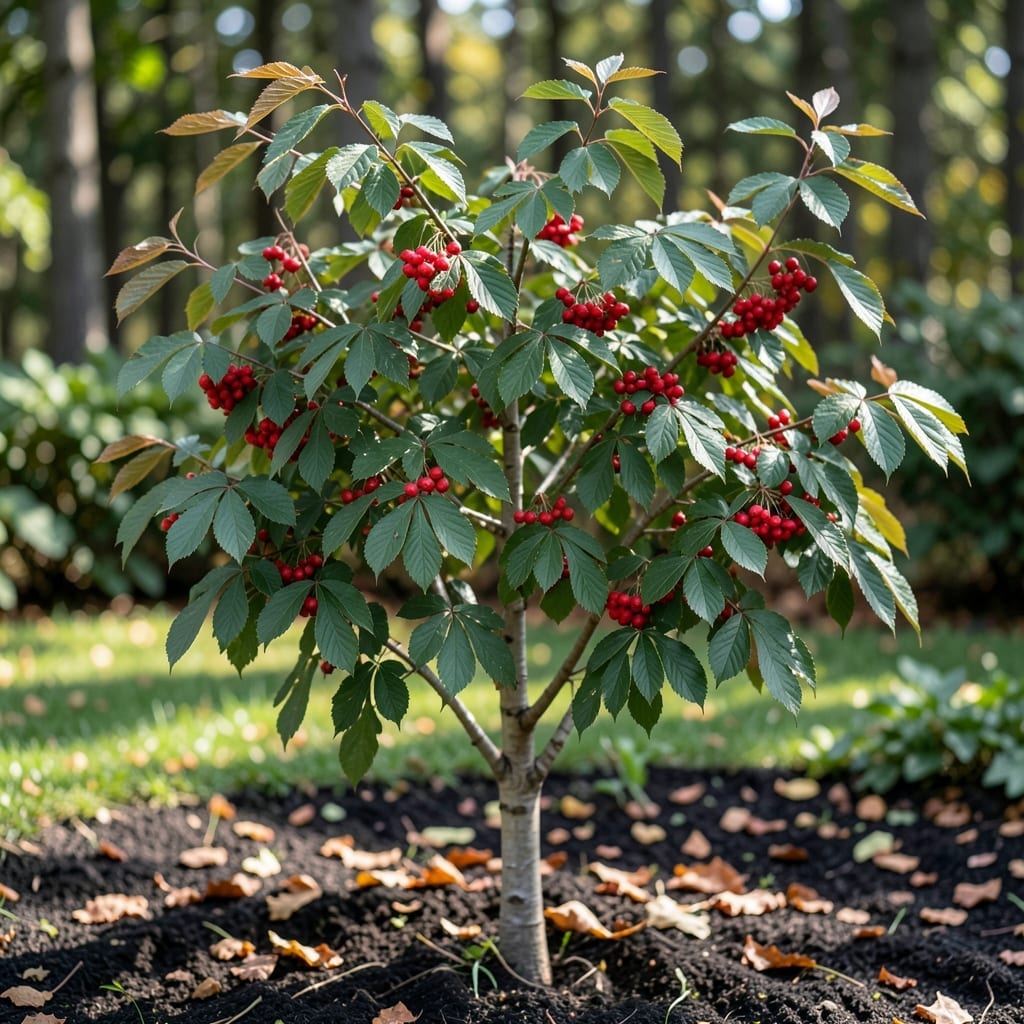
Seven pointed lobes and clusters of bright berries give mountain ash away. I spent years confusing it with maples until I noticed the jagged edges and the way the leaflets fan out like fingers on a hand.
The real tell? Those brilliant red or orange berries that birds love, hanging in heavy clusters. Even the bark has a distinctive diamond pattern that stands out in winter. Most look-alikes miss at least one of these marks.
Spotty leaves or curled edges usually signal trouble—often sawfly larvae or fungal spots. Catching these early means the difference between a thriving tree and one that struggles every season.
Works for backyard trees, forest walks, or just satisfying that curiosity about the tree in your neighbor’s yard. Here’s how to nail the ID every time.
Mountain ash leaves develop their distinctive lobes and serrated edges due to a mix of genetic and environmental factors. These traits aren’t random—they serve specific purposes for the tree’s survival and adaptation. Below are the key reasons behind their unique appearance.
Mountain ash (Sorbus spp.) inherits its leaf shape from its genetic code. The lobed and compound structure is a defining characteristic of the Rosaceae family, to which it belongs. This genetic programming ensures the leaves grow with 5–11 serrated leaflets arranged pinnately, optimizing sunlight capture while reducing wind resistance.
Evolution has fine-tuned mountain ash leaves to thrive in cool, temperate climates. The deep lobes and jagged edges help:
The sharp serrations and complex leaflet arrangement act as a natural defense. Insects and grazing animals find it harder to consume the leaves efficiently, reducing damage. Additionally, the bitter compounds in the foliage (like tannins) further discourage predators, ensuring the tree conserves energy for growth and reproduction.
Identifying mountain ash leaves can be tricky, but these practical fixes will help you master the process and avoid common pitfalls. Here’s how to solve specific challenges:
If you’re confusing mountain ash leaves with maple or oak, focus on the saw-toothed edges and pinnate arrangement (feather-like structure). Unlike maple leaves, mountain ash leaves have 5–11 small leaflets per stem. Fix: Count the leaflets and check for serrated margins. Compare side-by-side with a field guide or app like iNaturalist for confirmation.
Prevention: 💡 Always examine the full leaf structure, not just a single leaflet.
Mountain ash is famous for its bright red or orange berry clusters, but they’re often missed during leaf identification. Fix: Look for clusters of berries growing in corymbs (flat-topped groups) alongside the leaves. These berries appear in late summer to fall and are a dead giveaway.
Prevention: ✨ Inspect the tree year-round—berries may not be present in spring, but their absence can still hint at the species.
Mountain ash (often called rowan in some regions) can be confused with other Sorbus species. Fix: Note the leaflet shape—mountain ash leaflets are lance-shaped with fine teeth, while other rowans may have broader or smoother leaflets. Also, check the bark: mountain ash often has smooth, silvery-gray bark.
Prevention: 🎯 Use a regional plant database to compare local Sorbus species and their unique traits.
Leaves change color and shape slightly with the seasons, which can complicate identification. Fix: Observe the tree during summer when leaves are fully grown and green. Avoid relying solely on fall foliage, as colors vary widely.
Prevention: 🌡️ Take photos in different seasons and compare them to a trusted identification resource.
Mountain ash leaves typically have 5–11 leaflets arranged in a pinnate (feather-like) pattern. Each leaflet has serrated edges, which helps distinguish it from similar trees.
Maple leaves are simple and lobed, while mountain ash leaves are compound with multiple leaflets. Look for the saw-toothed margins and the berry clusters to confirm.
Yes, mountain ash leaves turn vibrant shades of red, orange, or purple in autumn. This seasonal shift can complicate identification, so summer observations are most reliable.
Focus on the compound leaf structure and serrated edges. The bark’s diamond pattern and smooth texture are also strong clues.