
Beautiful Plants For Your Interior
Beautiful Plants For Your Interior
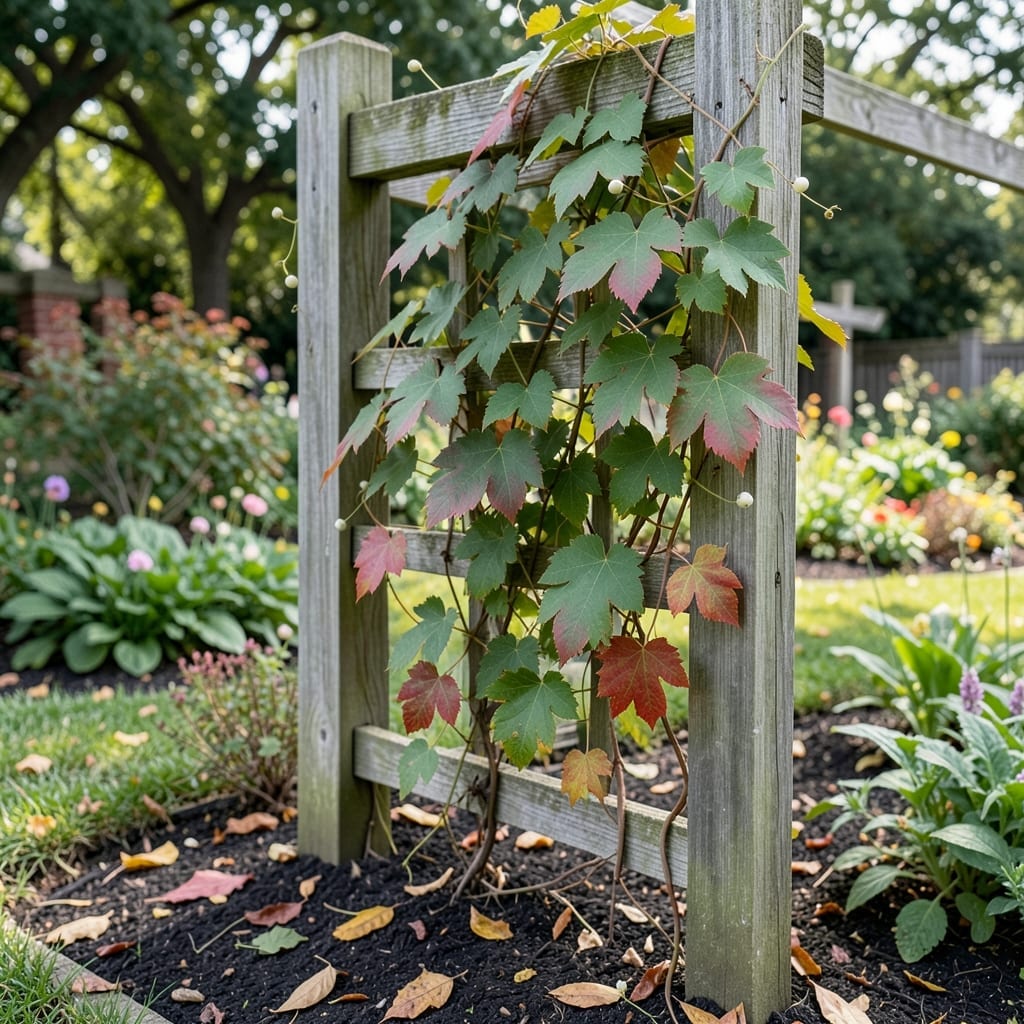
That five-leaf vine climbing your fence might just be Virginia creeper. I first spotted its distinctive palmate leaves twisting up an old oak, each cluster like a tiny starburst against the bark.
This native vine thrives in partial shade with minimal care, spreading 10-20 feet in a season if given room. The leaves turn a fiery red in fall, making it a showstopper even when not in bloom.
It handles poor soil and drought once established, but give it a trellis or wall to climb. Without support, it sprawls into a ground cover that can smother other plants.
Perfect for naturalizing wooded areas or adding vertical interest to your garden. Here’s how to spot it and help it thrive.
The five-leaf arrangement on vines like Parthenocissus quinquefolia (Virginia Creeper) isn’t random—it’s a product of evolutionary adaptation and botanical structure. Here’s why this distinctive pattern emerges:
Virginia Creeper is a pinnately compound plant, meaning its leaves are composed of multiple leaflets (typically five) attached to a central stem (rachis). This trait is hardwired into its DNA, ensuring consistent growth patterns. Each leaflet functions as a mini solar panel, maximizing photosynthesis while reducing wind resistance compared to a single large leaf.
The five-leaf design offers evolutionary perks. Smaller leaflets minimize water loss through transpiration and reduce damage from wind or herbivores. The arrangement also allows light to penetrate deeper into the vine’s canopy, aiding lower leaves in shaded forest understories—its natural habitat.
Auxins, a class of plant hormones, regulate leaf development. In Virginia Creeper, these hormones trigger the growth of leaflets in a symmetrical, five-part pattern from the central bud. Environmental factors like light and temperature can subtly influence leaflet size, but the five-leaf structure remains dominant.
If you’re puzzling over what vine has five leaves, the most likely culprit is the Virginia Creeper (Parthenocissus quinquefolia). Here’s how to confirm and address common confusion with lookalikes like poison ivy:
Virginia Creeper has five leaflets per leaf, arranged in a palmate (hand-like) pattern. Poison ivy, often mistaken for it, has three leaflets. Count the leaflets—this is the fastest way to tell them apart.
Virginia Creeper leaves turn vibrant red or purple in fall, while poison ivy stays green or yellowish. The edges of Virginia Creeper leaves are toothed, and the vine’s bark is shreddy. Poison ivy has smoother edges and a more glossy finish.
Virginia Creeper climbs via small tendrils with adhesive tips, clinging to walls or trees. Poison ivy grows as a shrub or vine but lacks these tendrils, often using root-like hairs to cling. Check the stem—Virginia Creeper’s is woody and older vines develop a thick, textured trunk.
When in doubt, snap a photo and compare it to verified images online—leaf count is your best friend! ✨
No, but it’s the most common. Other vines like woodbine (Parthenocissus vitacea) also have five leaflets, but Virginia creeper is the widespread native species. Always check stem and leaf texture for final confirmation.
Virginia creeper can damage wooden structures over time as its tendrils embed into surfaces. On trees, it’s generally harmless but may compete for light. Use a trellis to guide its growth away from sensitive areas.
Expect 10-20 feet per year in ideal conditions. It thrives in partial shade with moderate water but can tolerate drought once established. Prune in late winter to control its spread.