
Beautiful Plants For Your Interior
Beautiful Plants For Your Interior
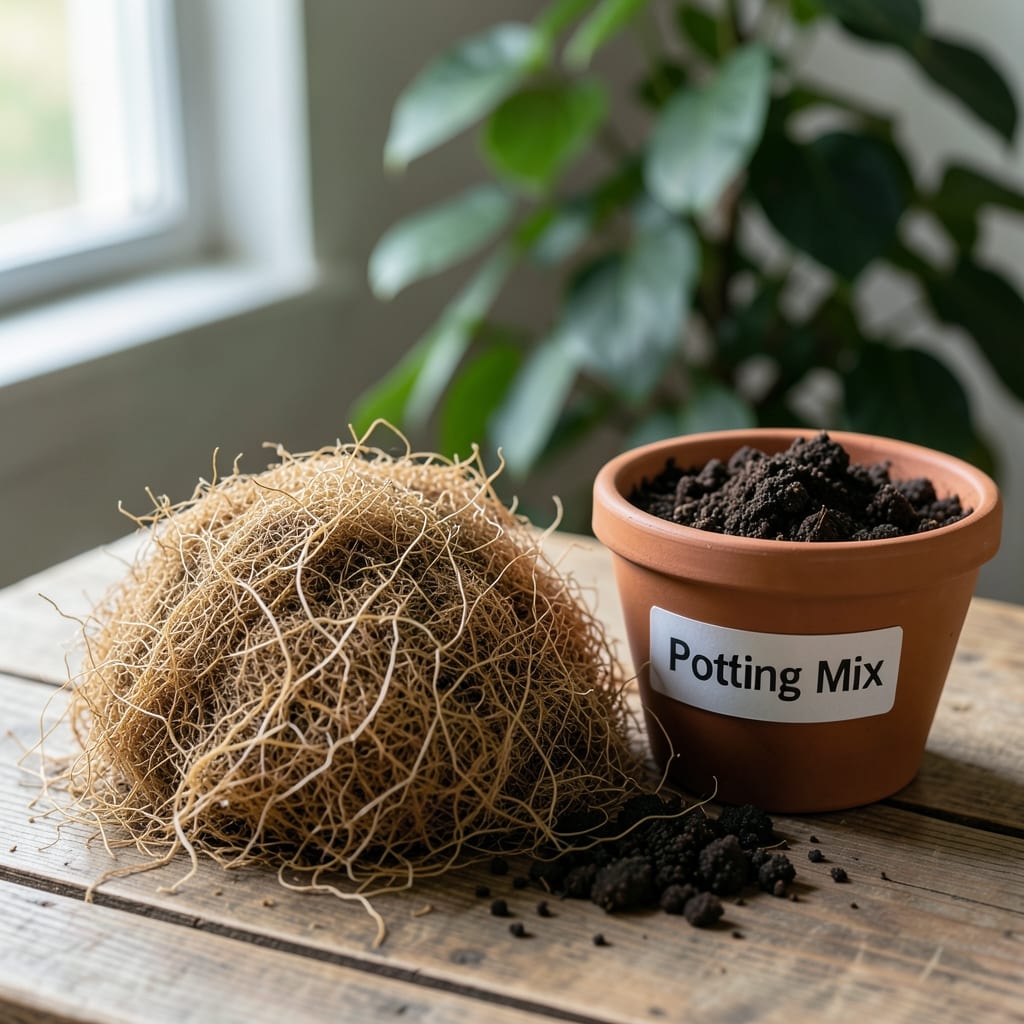
Coco coir is a natural, fibrous growing medium made from coconut husks, prized for its excellent water retention, aeration, and sustainability in gardening.
I love how this material transforms garden performance by holding 30% more moisture than peat while still draining well. It’s also naturally resistant to pests and diseases, which saves me countless headaches. Plus, it’s a renewable resource that gives coconut byproducts a second life in our gardens. ✨
What’s more, I’ve found it works wonders for both seedlings and mature plants, especially in container gardens where drainage is critical. 💫
💡 In This Article
Coconut husks undergo a multi-step transformation to become coir. First, the fibrous material between the shell and outer skin is extracted, soaked in water for 6-12 months to soften, then mechanically separated into long and short fibers. The pith is washed, dried, and graded into various textures, from fine dust to coarse chips.
This process removes salts and tannins, making it safe for plants. 🌟
The resulting medium has remarkable properties. It can hold 8-10 times its weight in water while still maintaining 20-30% air porosity, creating an ideal balance of moisture and oxygen for roots. Unlike peat moss, it rehydrates quickly even after drying out completely, and its pH sits at a neutral 5.5-6.5, perfect for most plants. ✨
What makes coir eco-friendly is its origin. It’s a byproduct of coconut harvesting, which would otherwise go to waste. The production process requires no mining or deforestation, and the medium itself is biodegradable. In fact, 1 coconut husk yields about 750g of coir, making it incredibly resource-efficient. 🔥
Its physical structure also resists compaction better than peat. The fibers create a network of macropores that maintain aeration even when saturated. This means roots get consistent access to oxygen, reducing the risk of suffocation or rot. I’ve seen seedlings thrive in coir where they’d struggle in denser media. 💫
Another advantage is its cation exchange capacity (CEC) of 40-60 meq/100g. This allows it to hold and slowly release nutrients to plant roots, acting like a natural fertilizer reservoir. It also means you can reuse coir for 2-3 growing seasons with proper management. 🌟
Most plants thrive in coco coir, but some acid-loving plants like blueberries may need pH adjustments. It works especially well for vegetables, herbs, and tropical plants. Always check your plant’s specific needs.
With proper care, coco coir can be reused for 2-3 growing seasons. It breaks down slowly and maintains its structure better than peat moss. Rinse between uses to remove salt buildup.
Rinsing is recommended to remove excess salts from processing. For hydroponics, soak for 12-24 hours to ensure full hydration. This step prevents potential nutrient imbalances.
A 1:2 ratio of coir to soil improves drainage in heavy soils and water retention in sandy ones. It’s an excellent way to enhance any garden bed.