
Beautiful Plants For Your Interior
Beautiful Plants For Your Interior
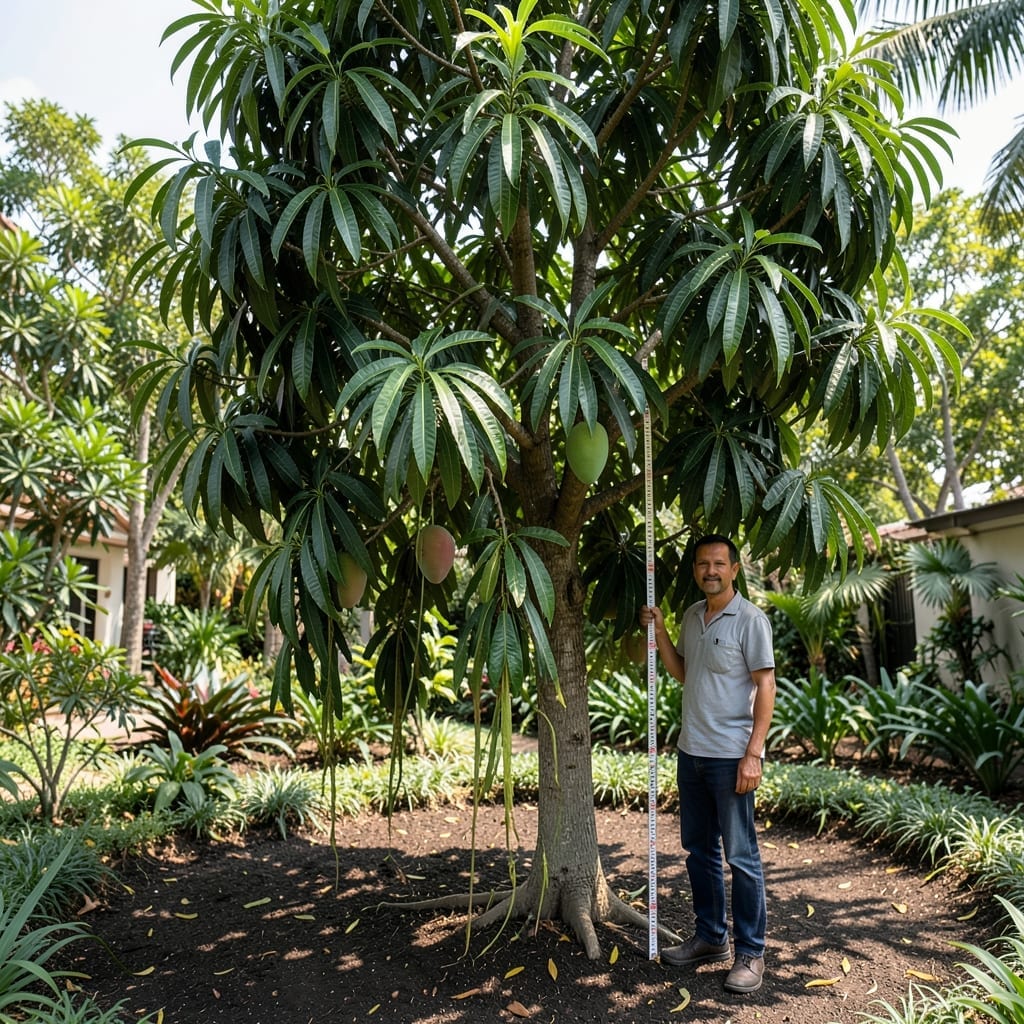
Mango trees are a tropical delight in any garden, but their towering height can surprise even seasoned growers. I remember planting my first 🥭 Mango Tree and watching it grow far beyond my initial expectations.
Understanding how tall these trees can get helps you plan your space and choose the right variety for your landscape. Whether you have acres of land or a small backyard, knowing the potential height is the key to successful cultivation.
Let me share what I’ve learned about the impressive growth of these fruit-bearing giants and how you can manage their size to fit your garden perfectly.

When I first planted a mango tree in my garden, I was amazed at how quickly it grew. These tropical beauties can reach impressive heights, but the exact size depends on the variety you choose.
Standard mango trees typically grow between 30 to 100 feet tall, while dwarf varieties stay much smaller. Knowing the mature size of your chosen type helps you plan your garden layout effectively.
| Variety | Mature Height | Growth Rate |
|---|---|---|
| Standard (e.g., Tommy Atkins) | 60-100 ft | Fast |
| Semi-Dwarf (e.g., Keitt) | 15-30 ft | Moderate |
| Dwarf (e.g., Cogshall) | 8-15 ft | Slow |
Standard varieties like Tommy Atkins and Kent can grow as tall as a 10-story building. These are best suited for large landscapes where space isn’t an issue.
For smaller gardens, I recommend semi-dwarf varieties like Keitt or Haden. These typically reach 15 to 30 feet at maturity, making them more manageable for home gardeners.
If space is truly limited, dwarf mango trees like Cogshall or Ice Cream are perfect. They stay compact at 8 to 15 feet tall while still producing delicious fruit.
The growth rate varies too. Standard trees grow quickly, often adding 3 to 5 feet per year under ideal conditions. Dwarf types grow more slowly, which is great for container gardening.
I’ve found that climate conditions significantly impact growth. In tropical zones, mango trees grow taller faster, while in cooler areas, they may stay smaller but still produce well.
Remember that pruning practices can help control height. Regular pruning keeps trees at a manageable size while promoting better fruit production and air circulation.
For container growing, dwarf varieties are your best bet. With proper care and annual root pruning, you can keep these trees thriving in large pots on a patio or balcony.
No matter which variety you choose, proper spacing is crucial. I always recommend planting standard trees at least 25 to 30 feet apart to allow for their full growth potential.
Several key factors determine how tall your mango tree will grow. I’ve seen firsthand how climate conditions can drastically affect height, with tropical zones producing the tallest specimens.
In my experience, soil quality plays a major role too. Well-draining, nutrient-rich soil encourages strong root development, which directly impacts upward growth potential.
I always recommend consistent watering during the growing season. Mango trees need about 1 inch of water per week, either from rain or irrigation, to reach their full height potential.
Pruning techniques are my go-to for height control. By pruning the central leader and lateral branches, you can limit vertical growth while maintaining a bushier shape.
For container growing, I’ve found that root restriction naturally limits height. Dwarf varieties in 20-gallon pots typically stay under 10 feet tall, perfect for patios.
Remember that sunlight exposure is crucial. Mango trees need full sun (8+ hours daily) to grow tall and produce abundant fruit. Shaded trees often remain stunted.
Lastly, fertilization impacts growth rate. I use a balanced 6-6-6 fertilizer every 4-6 weeks during the growing season to support healthy development.