
Beautiful Plants For Your Interior
Beautiful Plants For Your Interior
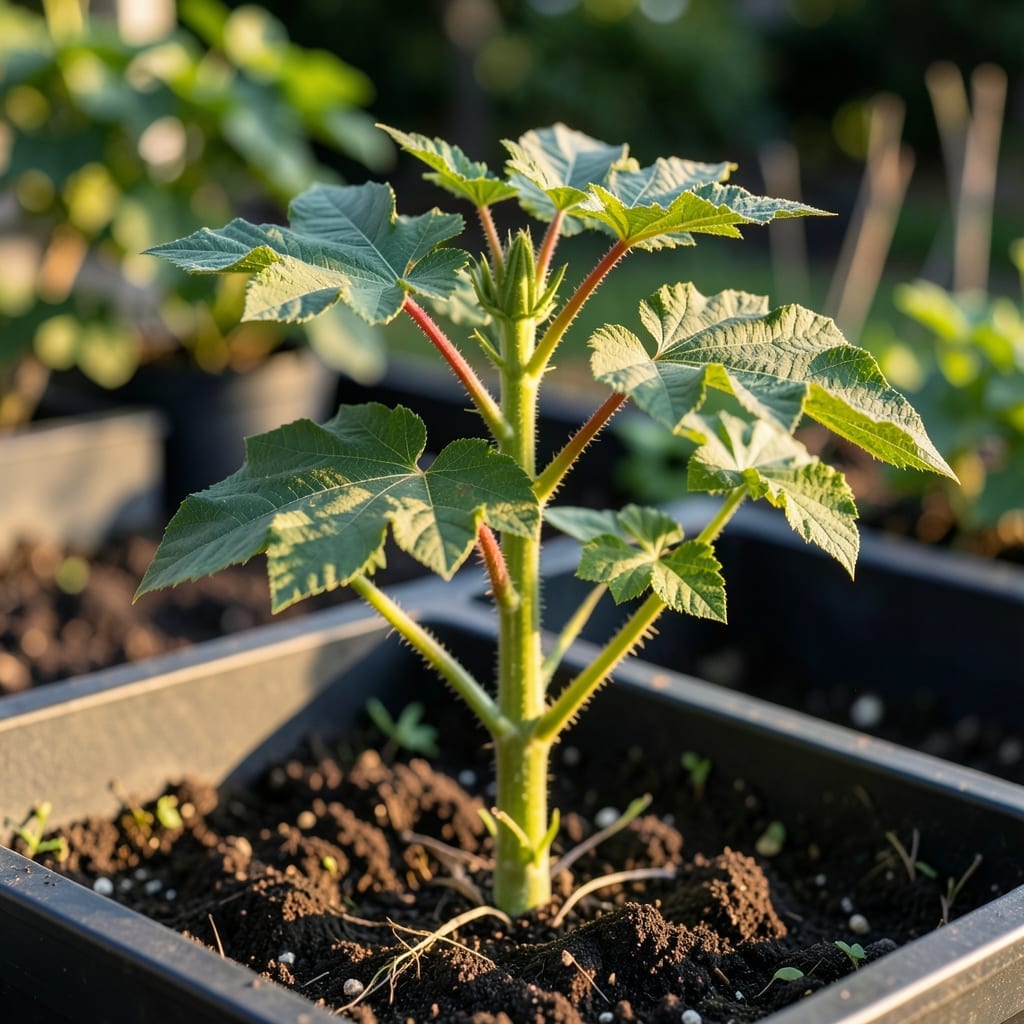
First time growing okra from seed? You’ll spot those sprouts in about 5-10 days—tiny green shoots with heart-shaped leaves pushing through the soil.
They look like miniature okra pods at first, but the real giveaway is the star-shaped cross section when you slice them open. Healthy sprouts have bright green stems and leaves, not yellow or wilted.
If they’re leggy or pale, they’re stretching for light. Move them to a sunnier spot or supplement with a grow light to keep them stocky and strong.
Watch for the first true leaves after the initial pair—they’ll look more like classic okra foliage, and that’s when you know your plants are off to a solid start.
Okra sprouts develop their distinctive tiny green pods with star-shaped cross sections due to a combination of genetic and environmental factors. Below are the primary causes behind their unique appearance:
Okra (Abelmoschus esculentus) is hardwired to produce pods with a pentagonal (5-sided) or star-shaped internal structure. This trait is inherited from its wild ancestors, where the shape helped with seed dispersal and protection. The fibrous ridges on the pod’s exterior correspond to the internal chambers, creating the star pattern when sliced.
During the sprouting phase, okra plants undergo accelerated cell division in the ovary (the part that becomes the pod). The growth is uneven, with vascular bundles (water and nutrient channels) forming in a radial pattern. This causes the pod to expand outward in a ribbed, angular fashion rather than smoothly.
Sunlight, temperature, and water availability influence pod formation. Full sun exposure (6+ hours daily) promotes robust ridge development, while consistent moisture ensures uniform growth. Stress conditions (drought or extreme heat) may distort the star shape, but ideal conditions highlight it.
Plant hormones like auxin and gibberellins regulate pod elongation and ridging. Auxin concentrates at the pod’s edges, stimulating differential growth rates that deepen the ridges. Gibberellins then stretch the pod lengthwise, preserving the star-shaped cross section.
In short, okra sprouts look the way they do because of evolutionary design, cellular growth patterns, and environmental harmony—all working in tandem!
If you’re unsure whether those tiny green shoots are okra sprouts, here’s how to confirm and address common concerns:
Okra sprouts have heart-shaped or slightly rounded leaves with a velvety texture. If your seedlings look like clover or grass, they’re likely weeds. Fix: Gently uproot suspicious plants and compare leaves to confirmed okra sprouts. To prevent mix-ups, mark okra rows with labels or sticks during planting.
New okra sprouts can be as tiny as 1–2 inches tall. If unsure, give them 3–5 days to grow. True okra sprouts will develop distinctive ridged stems and star-shaped cross sections in the pods later. Prevention tip: Plant seeds in neat rows for easier identification early on.
Okra sprouts can resemble cotton or hibiscus (they’re in the same family!). Fix: Rub a leaf between your fingers—okra leaves feel slightly fuzzy. Also, okra stems are green with purplish tinges, while cotton stems are more uniformly green. 💡 Pro tip: Keep a reference photo of young okra plants handy for quick comparisons.
When in doubt, let them grow a bit longer—okra’s unique pods and star-shaped slices will confirm their identity!
Sprouts emerge at 1-2 inches with heart-shaped leaves. By 3-4 inches, they develop the first true leaves that resemble mature okra foliage. The star-shaped pod cross section becomes visible once pods form at 6-8 inches tall.
This happens when they stretch for light. Move them to full sun (6+ hours daily) or use a grow light. Space seeds 12-18 inches apart to prevent competition. Healthy sprouts stay stocky with bright green leaves.
Yes, but use 12-inch deep containers and a south-facing window. Supplement with grow lights for 14-16 hours daily. Okra needs warmth (70-95°F) and consistent moisture to thrive indoors.