
Beautiful Plants For Your Interior
Beautiful Plants For Your Interior
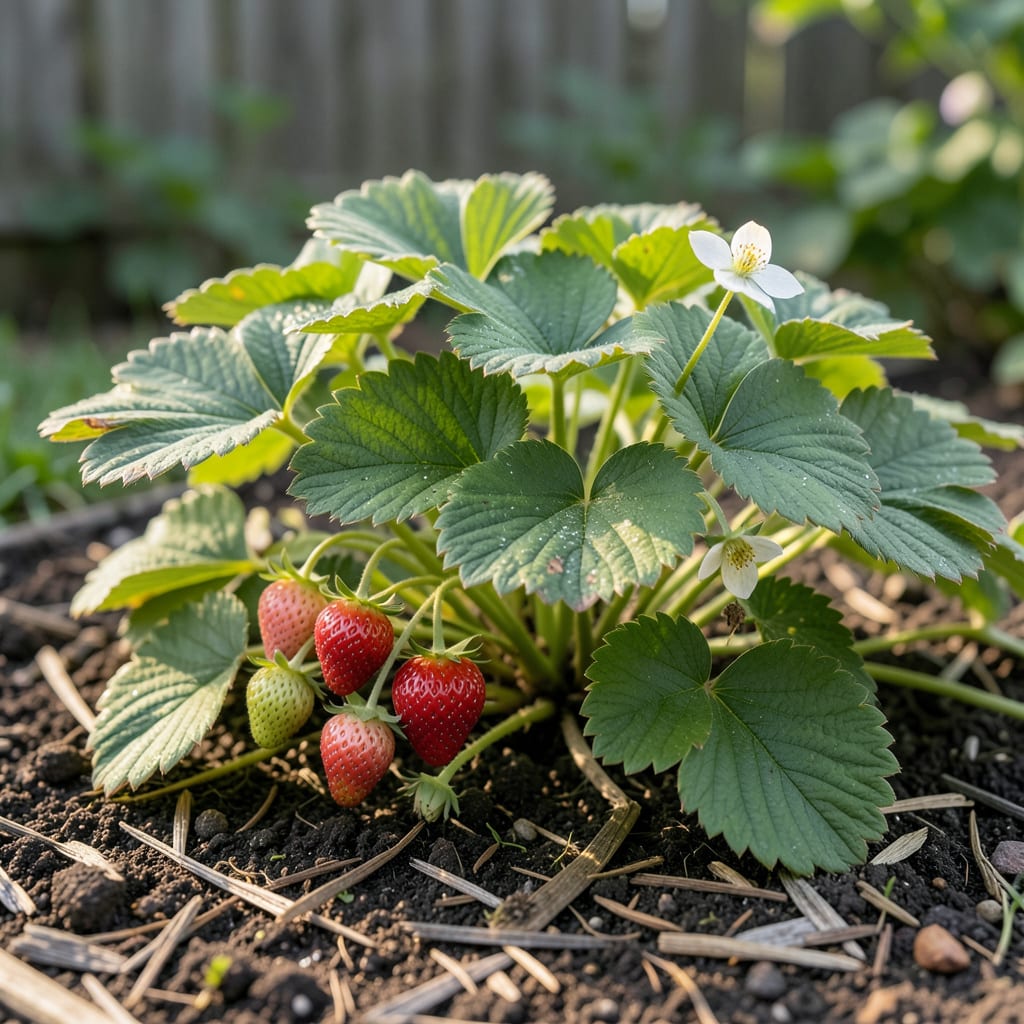
Strawberry plants feature trifoliate leaves with serrated edges, white five-petaled flowers, and runners that spread horizontally. The fruit develops from the flower base, starting green and ripening to red. Plants grow low to the ground in bushy clusters about 6-12 inches tall.
I love how strawberry plants transform through their growth cycle. The toothed leaves (technically called “trifoliate” because they grow in groups of three) create a vibrant green carpet that makes the bright red berries pop dramatically. 🔥 What’s fascinating is how the horizontal runners—those long, thin stems—actually create new baby plants, which is why strawberries often spread so quickly in gardens. The delicate white flowers with yellow centers are the first sign that fruit is coming, and watching them turn into berries is one of my favorite parts of growing them.
💡 In This Article
The trifoliate leaves of strawberry plants are their most distinctive feature. Each leaf consists of three leaflets with deeply serrated edges, resembling tiny saw blades. The leaves emerge on hairy petioles that can reach 4-6 inches long, creating that classic “strawberry plant” silhouette.
What’s particularly interesting is the leaf color variation—new growth appears bright lime green, while mature leaves develop a deeper emerald hue with prominent veins.
Strawberry flowers are nature’s perfect design for pollination. Each bloom has five white petals surrounding a yellow center packed with 20-35 stamens. The flowers grow on slender stems that rise just above the foliage, making them easily accessible to bees.
🐝 A single plant can produce dozens of flowers over its lifetime, with each flower capable of developing into a berry if properly pollinated. The petals are delicate but surprisingly resilient, often lasting 3-5 days before falling away.
The fruit development process is where strawberries show their unique biology. Unlike most fruits that develop from the ovary, strawberries form from the flower’s receptacle—the swollen stem tissue at the base. This is why the “seeds” (actually achene fruits) appear on the outside.
The berries start as tiny green bumps, gradually enlarging and changing color over 4-6 weeks. During ripening, they transition from pale green to white, then pink, finally reaching that signature bright red we all recognize.
Beneath the soil, strawberry plants develop a fibrous root system that spreads horizontally rather than growing deep. The roots typically extend 6-12 inches outward, with most activity concentrated in the top 6 inches of soil. This shallow root structure explains why strawberries thrive in raised beds and containers.
The crown—where leaves, flowers, and runners emerge—remains at soil level, which is crucial for preventing rot while allowing new growth to spread.
What often surprises gardeners are the runners—those long, thin stems that arch away from the mother plant. These can grow 12-24 inches long, with tiny plantlets forming at nodes along the runner. Each plantlet can develop its own root system and become an independent plant. This vegetative reproduction is why strawberry patches expand so rapidly.
The runners appear after the main fruiting season, typically in late summer or early fall, depending on your climate zone.
When comparing strawberries to lookalikes, the leaf structure is your best identifier. Mock strawberries (Potentilla indica) have similar trifoliate leaves but with smoother edges and yellow flowers. Wild strawberries (Fragaria vesca) are nearly identical but produce much smaller berries.
The key difference is in the leaf texture—cultivated strawberries have a slightly rough, sandpaper-like feel due to tiny hairs on the leaf surface, while wild varieties feel smoother to the touch.
Seasonal changes dramatically alter strawberry plants’ appearance. In spring, you’ll see rapid leaf growth and flower production. Summer brings fruit development and runner formation. By fall, the plants prepare for dormancy, with leaves often turning reddish or purple in cold climates.
Winter dormancy causes the plants to die back to the crown, with new growth emerging in early spring. This cycle explains why strawberries are often classified as perennial plants—they return year after year from the same crown.
The texture of strawberry leaves provides another identification clue. Run your fingers along a leaf and you’ll feel the slight roughness from tiny hairs (trichomes). These hairs serve multiple purposes—they help reduce water loss, protect against pests, and even reflect excess sunlight.
The underside of the leaves appears lighter green with more prominent veins, while the topside has a slightly waxy coating that helps water bead up and roll off.
For gardeners trying to identify strawberry plants, focus on this combination: trifoliate leaves with serrated edges, white flowers with yellow centers, and the distinctive runners. The fruit’s development pattern—from green bumps to red berries with external seeds—is unique in the plant world.
Once you recognize these characteristics, you’ll spot strawberry plants anywhere, from garden beds to wild patches along hiking trails. ✨
Strawberry plants stand out with their trifoliate leaves (three leaflets per stem) and serrated edges. Weeds typically have simpler leaf structures. Look for the horizontal runners and white flowers—these are dead giveaways it’s a strawberry plant, not a weed.
While both have three leaflets, strawberry leaves have toothed edges and a rough texture, while clover leaves are smooth with a rounded heart shape. Strawberry leaves also grow on longer stems (4-6 inches) and have more prominent veins.
Most share core traits, but variations exist. June-bearing types have larger leaves and more runners, while day-neutral varieties stay more compact. Alpine strawberries produce smaller leaves and berries. The flowers and fruit development process remains similar across varieties.
Purple leaves often indicate phosphorus deficiency or cold stress. In fall, it’s normal as plants prepare for dormancy. If it happens in spring/summer, test your soil and consider a balanced fertilizer. The purple tint usually appears on leaf undersides first.
Focus on the trifoliate leaves with serrated edges and hairy petioles. The plants grow in low, bushy clusters about 6-12 inches tall. Runners (if present) are another clue. The leaves have a slightly rough texture when touched—unlike most weeds or lookalikes.
