
Beautiful Plants For Your Interior
Beautiful Plants For Your Interior
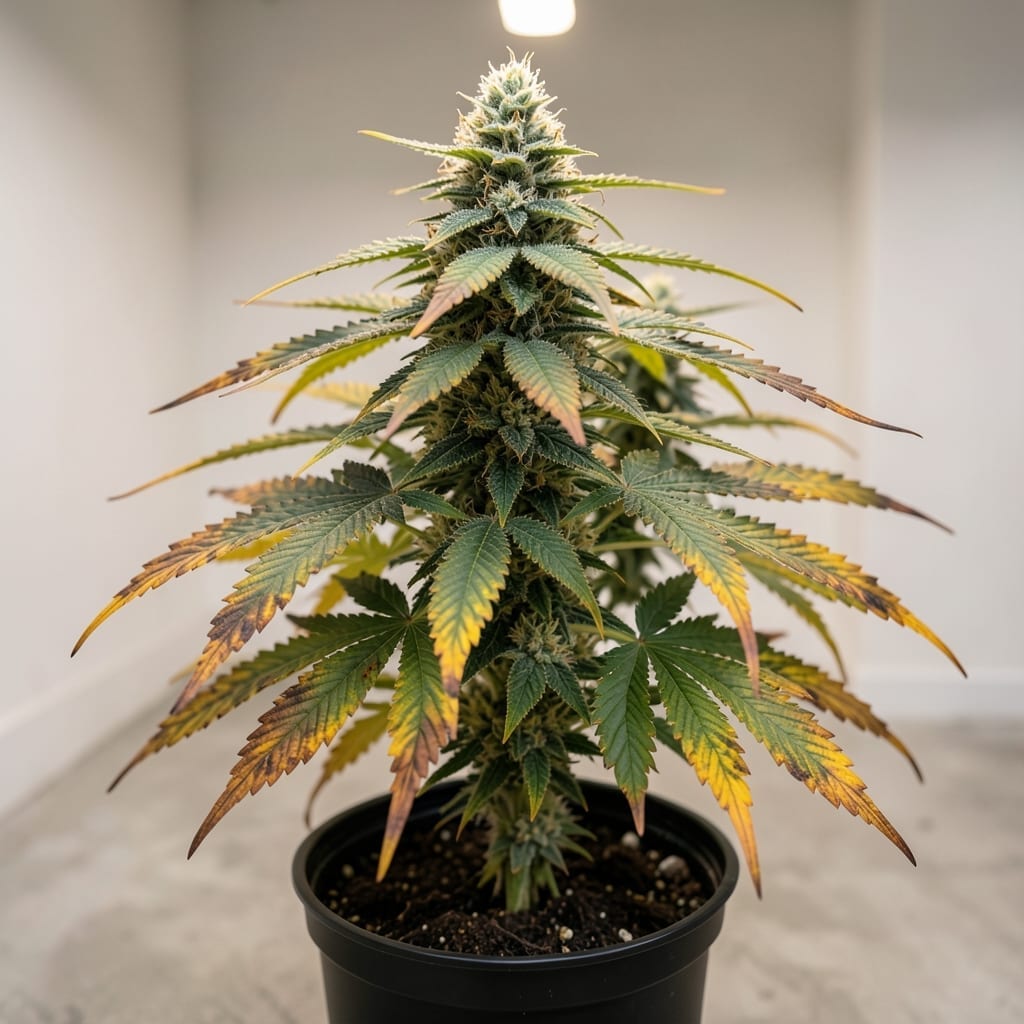
Brown leaf tips and crispy edges don’t lie. I’ve seen nutrient burn wreck cannabis plants in 48 hours, turning lush growth into a sad, overfed mess.
This happens when enthusiasm outweighs precision—too much of a good thing becomes toxic. The plant can’t process excess nutrients, so it burns from the inside out, starting at the tips where concentrations are highest.
Recovery is possible, but it requires flushing the medium and dialing back the feed. Within 7-10 days, new growth should emerge healthy and green if you act fast.
Prevention is simpler than cure: start low, go slow, and watch the plant’s response like a hawk. Consistent monitoring keeps your crop thriving, not just surviving.
Nutrient burn (or “nute burn”) in cannabis occurs when the plant absorbs excess nutrients, particularly nitrogen (N), phosphorus (P), and potassium (K), faster than it can process them. This overload disrupts cellular function, leading to the characteristic leaf tip burn and other stress symptoms. Below are the primary causes, explained with actionable insights.
The most common culprit is excessive fertilizer application. Growers often assume “more nutrients = better growth,” but cannabis plants have a finite capacity for uptake. High concentrations of salts in synthetic or organic fertilizers raise the electrical conductivity (EC) of the growing medium, forcing roots to absorb more ions than the plant can metabolize. This triggers osmotic stress, where water is pulled out of root cells, causing dehydration and tip burn.
Even balanced nutrient solutions can cause burn if the pH is off. Cannabis thrives in a pH range of 5.8–6.5 for soil and 5.5–6.2 for hydroponics. Outside this range, nutrients become less bioavailable, but the plant may still absorb them in toxic forms. For example, ammonium (NH₄⁺) toxicity can occur at low pH, while high pH may lock out calcium and magnesium, indirectly stressing the plant and exacerbating burn-like symptoms.
High temperatures (above 85°F/29°C) accelerate evaporation, increasing the concentration of dissolved nutrients in the root zone. As water evaporates, salts and minerals left behind become more potent, effectively “supercharging” the solution. This is especially risky in hydroponic or coco coir systems, where there’s less buffer against salt buildup. Heat also speeds up metabolic rates, causing the plant to uptake nutrients faster than it can use them.
In soil or soilless mixes, repeated watering without flushing leads to salt accumulation. Each feeding adds more minerals, and without periodic leaching (e.g., with plain pH-balanced water), the EC in the medium climbs. Older leaves often show burn first because they act as nutrient reservoirs, storing excess ions until toxicity manifests as necrosis.
When your cannabis plants show signs of nutrient burn, quick and targeted action can turn things around. Below are practical fixes for each cause, along with prevention tips to keep your plants thriving.
If excess nutrients are the culprit, flush the growing medium with pH-balanced water (6.0–6.5 for soil, 5.5–6.2 for hydroponics) to remove built-up salts. Run 2–3 times the pot’s volume through the soil. After flushing, reduce nutrient strength by 50% for the next feeding. Gradually increase only if plants show recovery.
Prevention: Always follow the “less is more” rule. Start with half the recommended dose and monitor plant response. Use a TDS meter to track nutrient levels in your solution.
High temperatures can intensify nutrient uptake, leading to burn. Lower the room temperature to 70–85°F (21–29°C) and ensure proper airflow with fans. If using grow lights, increase the distance or reduce intensity.
Prevention: Invest in a thermometer/hygrometer to monitor climate conditions. Use shade cloths or adjust lighting schedules during heatwaves.
Root-bound plants or compacted soil can trap nutrients, causing burn. Repot into a larger container with fresh, well-draining soil mix (add perlite or coco coir for aeration). For hydroponics, check for clogged drains and clean the system.
Prevention: Use fabric pots for better root aeration and avoid overwatering. Ensure your medium has at least 20% perlite or sand for drainage.
Too much nitrogen or phosphorus can lock out other nutrients. Test your runoff water with a ppm/EC meter. If levels are high, flush and switch to a balanced, mild nutrient formula (e.g., 3-1-2 NPK ratio) until recovery.
Prevention: Rotate nutrient types and avoid mixing brands without compatibility checks. Keep a feeding journal to track what works.
Pro Tip 💡: Yellowing leaves won’t recover, but new growth will if you act fast. Trim damaged foliage to redirect energy to healthy parts.
Look for crispy brown tips on leaves, especially older ones, with yellowing between veins. Unlike pests or disease, burn starts at leaf edges and works inward. New growth often appears healthy if caught early.
Rarely. Severe cases can stunt growth and reduce yields, but plants usually recover with proper flushing and adjusted feeding. The biggest risk is secondary infections through damaged foliage.
With immediate action, new healthy growth typically appears in 7-10 days. Damaged leaves won’t heal but can be trimmed. Full recovery may take 2-3 weeks depending on severity.
No, but reduce strength by 50% for the first feeding after flushing. Monitor plant response for 3-5 days before gradually increasing. Always use pH-balanced water.