
Beautiful Plants For Your Interior
Beautiful Plants For Your Interior
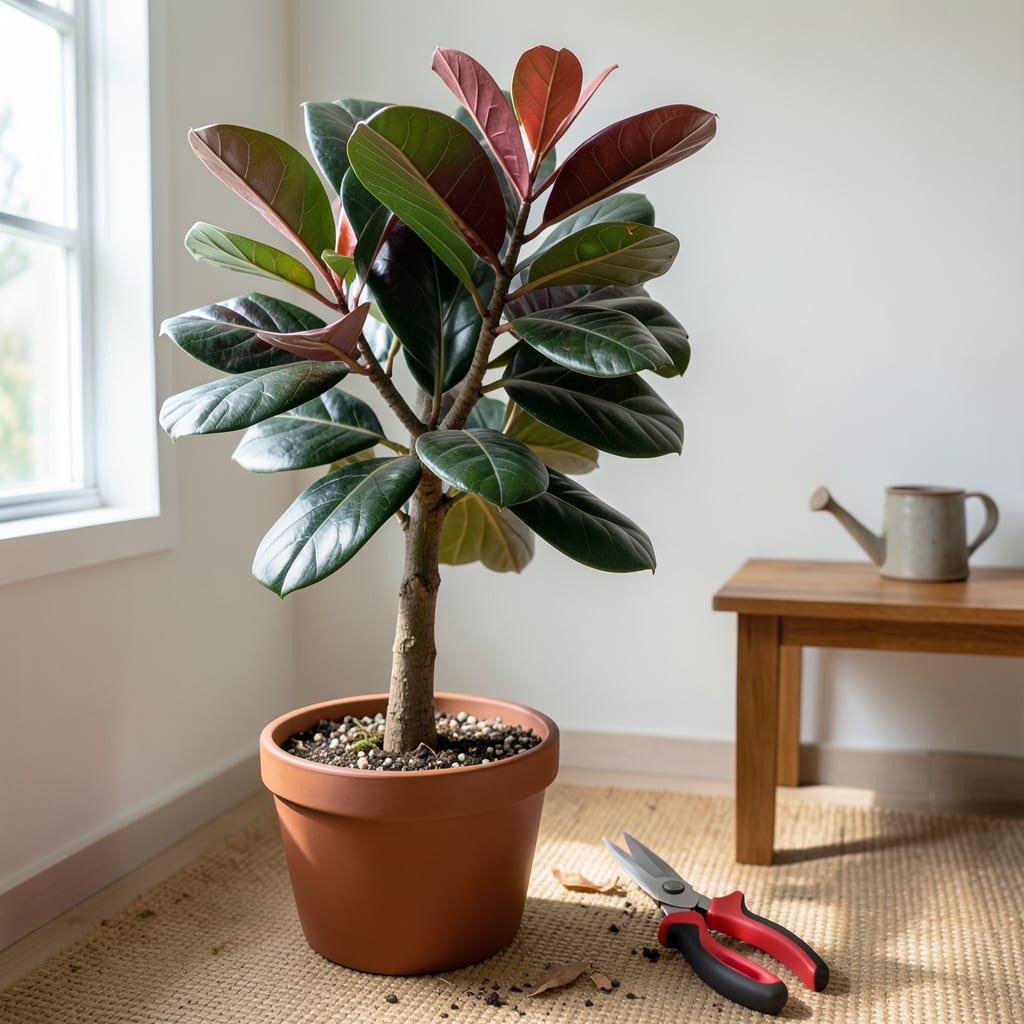
Your once-manageable rubber tree is suddenly stretching toward the ceiling like it’s in a race to the sky. If you’ve noticed it growing taller but sparser, you’re not alone—this is a common struggle with Ficus elastica when left unchecked.
The good news? You don’t need a green thumb to fix it. With the right pinch-prune method and a few adjustments to light and care, you can keep your rubber tree compact and full. Let’s break down the exact steps to stop the upward surge—without harming your plant.

If your rubber tree is turning into an indoor redwood, don’t panic! The pinch-prune method is your secret weapon. This technique stops vertical growth by removing the apical bud—the tiny growth point at the tip of each stem. Without it, your plant redirects energy sideways instead of upward.
Timing matters: spring or early summer is ideal, when your rubber tree is actively growing. Avoid pruning in winter dormancy, as the plant heals slower. I’ll walk you through the exact steps to keep your Ficus elastica compact and bushy without shocking it.
After pruning, your rubber tree might look a bit bare—but this is temporary! Within 4-6 weeks, you’ll see new side shoots emerging. These will fill out the plant, creating that lush, compact shape you’re after. Just be patient and resist the urge to over-prune.
Pro tip: If you’re nervous about making mistakes, start with smaller cuts on lower branches. This lets you practice while still controlling height. Remember, rubber trees are resilient—they bounce back quickly from proper pruning. I’ve seen plants recover from even aggressive cuts when done correctly.
For extra insurance against overgrowth, pair pruning with light adjustments. Move your plant slightly farther from the window after pruning to slow its recovery growth. This one-two punch keeps your rubber tree manageable long-term without constant maintenance.
Watch for new growth direction—if you notice one stem shooting upward faster than others, give it a quick pinch. This maintains balance and prevents your plant from developing a lopsided appearance. Regular small adjustments work better than occasional drastic pruning sessions.
If you’re growing a variegated rubber tree, be extra gentle. These varieties grow slower and may take longer to recover from pruning. I recommend removing no more than 20% of foliage at once for variegated types to avoid stressing the plant.
Don’t forget about the root system! If your rubber tree is root-bound, it may grow taller faster as it searches for space. Check roots every 12-18 months and upgrade pot size by 2 inches if needed—this prevents upward growth spurts caused by root congestion.
Finally, celebrate your cuttings! Each pruned stem can become a new plant. I’ve propagated dozens of rubber trees this way—great for gifts or expanding your indoor jungle. Just change the water weekly and wait for roots to reach 2-3 inches before potting.
If you’re hesitant to grab the shears, don’t worry—there are non-pruning ways to keep your rubber tree from outgrowing its space. These methods work with the plant’s natural growth patterns to slow vertical expansion while maintaining its health. Let’s explore some effective alternatives!
One of the simplest approaches is light manipulation. Rubber trees grow tall when reaching for light, so reducing overhead brightness can naturally slow their upward stretch. I’ve found that moving my rubber tree slightly away from the window or using sheer curtains creates a low-light environment that discourages rapid height gain.
| Method | Effectiveness | Ease of Use | Best For |
|---|---|---|---|
| Light Reduction | ⭐⭐⭐⭐ | ⭐⭐⭐⭐⭐ | Indoor growers with adjustable lighting |
| Root Pruning | ⭐⭐⭐⭐ | ⭐⭐⭐ | Container-grown plants needing refresh |
| Growth Regulators | ⭐⭐⭐⭐⭐ | ⭐⭐ | Advanced growers comfortable with hormones |
| Pot Size Control | ⭐⭐⭐ | ⭐⭐⭐⭐⭐ | All rubber tree owners |
Root pruning is another excellent technique for container-grown rubber trees. Every 2-3 years, I carefully trim about one-third of the roots when repotting, which naturally restricts upward growth. This method mimics the confined root space plants experience in nature, sending signals to focus energy on foliage rather than height.
For those comfortable with more advanced techniques, growth-regulating hormones can be highly effective. Products containing cytokinins or gibberellin inhibitors can significantly slow vertical growth. I recommend starting with natural options like kelp extract before trying synthetic hormones, as they’re gentler on the plant.
Don’t overlook the power of pot size control. A rubber tree in a smaller container (relative to its size) will naturally grow more slowly. I keep my rubber trees in pots that are just 2-3 inches wider than their root ball—this prevents excessive root expansion while still allowing healthy growth.
Remember that consistency is key with these methods. It’s better to make small, regular adjustments than drastic changes. I’ve found that combining light control with occasional root pruning gives the best results for maintaining a compact, healthy rubber tree without frequent pruning.
Whichever method you choose, always monitor your plant’s response. If you notice yellowing leaves or stunted growth, it might be time to adjust your approach. The goal is to create a balanced environment where your rubber tree thrives without becoming a ceiling-scraping giant! 🌳
If your rubber tree is shooting up like a skyscraper, chances are you’re accidentally encouraging its rapid growth. The good news? Most of these issues are easy to fix once you know what to look for. Let’s tackle the top five mistakes that turn your compact houseplant into a ceiling-scraping nuisance.
First, over-fertilizing is the biggest culprit. Rubber trees respond aggressively to nitrogen-heavy fertilizers, which fuel vertical growth at the expense of bushiness. If you’re feeding more than once a month during the growing season—or using undiluted fertilizer—you’re likely pushing your plant to grow taller, faster.
Another sneaky issue is pot size. A container that’s too large gives roots room to spread, signaling the plant to grow taller to match its expanded root system. Stick to a pot just 2-3 inches wider than the root ball. For example, if your rubber tree is in a 10-inch pot, upgrade to a 12-inch—not a 14-inch.
Light exposure plays a huge role too. If your plant isn’t rotated regularly, it will stretch toward the light source, creating a lopsided, leggy appearance. I recommend a quarter-turn every week to keep growth even. Place it near an east-facing window for gentle morning sun, which encourages compact, sturdy stems.
Finally, don’t ignore early signs of rapid growth. When new shoots reach 6-8 inches, pinch the tips to redirect energy to side branches. This simple step prevents a top-heavy plant and keeps your rubber tree full and manageable. Combine these fixes, and you’ll maintain a bushy, proportional plant instead of a towering eyesore. 🌱
Plan to prune every 6-12 months during active growth seasons (spring/early summer). For fast-growing varieties, check monthly and pinch new shoots at 6-8 inches tall. Regular small trims work better than occasional drastic cuts.
No, proper topping won’t harm a healthy plant! Cut just above a leaf node at a 45° angle using clean shears. This actually stimulates bushier growth by removing the apical bud. Just avoid removing more than 30% of foliage at once.
In a pinch, yes—but sharp pruning shears are ideal. Household scissors can crush stems if dull. If using scissors, disinfect with rubbing alcohol first and make clean cuts. For thick stems (>½ inch), shears are safer and create cleaner wounds.
Uneven growth usually means inconsistent light exposure. Rotate your plant ¼ turn weekly and ensure even brightness. If one side grows faster, that’s where the strongest light source is. Adjust positioning or use a grow light for balanced growth.
Combine these three steps: 1) Move to lower light (but not dark), 2) reduce watering frequency by 25%, and 3) skip fertilizer. This mimics winter conditions, naturally slowing growth without harming the plant. Expect visible slowing within 2-3 weeks.
