
Beautiful Plants For Your Interior
Beautiful Plants For Your Interior
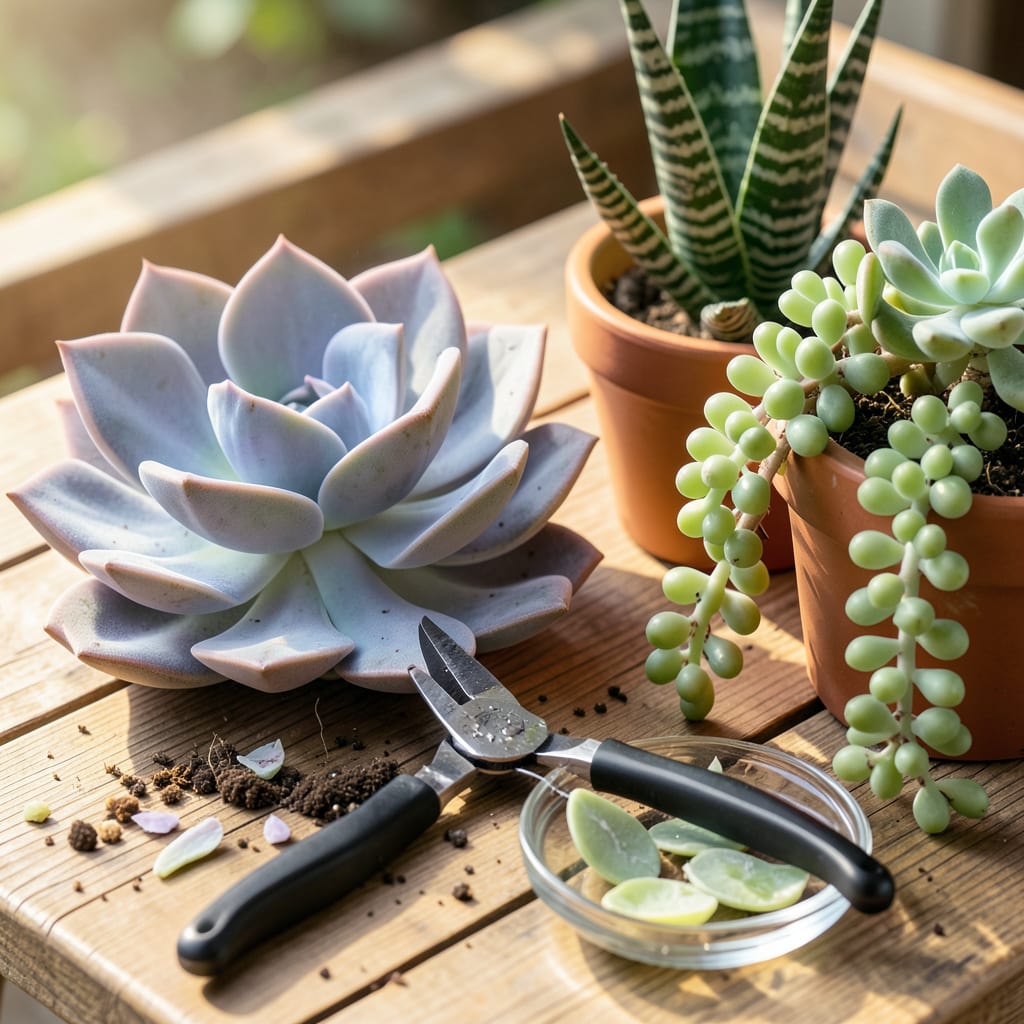
Succulents thrive on tough love—and pruning is where it starts. I used to let mine grow wild until I realized that strategic cuts transform leggy plants into compact, vibrant specimens. The right pruning encourages bushier growth, removes damaged leaves, and even gives you free plants through propagation.
Timing and technique matter more than fancy tools. A clean pair of scissors and 10 minutes is all you need to reshape overgrown succulents or revive struggling ones. You’ll see new growth within 2-3 weeks, with tighter rosettes and healthier stems. No green thumb required—just follow the simple rules that keep these desert natives thriving.
📚 In This Guide
This method transforms leggy, overgrown plants into compact, vibrant specimens—no guesswork required.
Examine your succulent for etiolated growth (stretched stems with wide gaps between leaves) or damaged foliage. I focus on the top 1/3 of the plant where new growth is most vigorous. Use sterilized, sharp pruning shears or micro-tip snips—dull blades crush stems, inviting rot.
Look for natural separation points where leaves meet the stem. These leaf nodes are where new growth will emerge after pruning. Disinfect tools with 70% isopropyl alcohol between plants to prevent cross-contamination of pathogens that thrive in succulent wounds.
Position your shears 1/4 inch above a leaf node and cut at a 45-degree angle. This sloped cut prevents water pooling on the wound while maximizing surface area for callusing. For rosette types like echeverias, I remove entire stems at the base when they’ve grown taller than the main plant’s diameter.
Never leave stubs—these die back and create entry points for fungal spores. You’ll feel slight resistance as you cut through the stem’s vascular tissue; a clean slice indicates proper technique. Immediately set aside healthy cuttings for propagation—they’ll root readily once callused.
Gently twist bottom leaves from the stem if they’re yellowed or damaged. Healthy leaves should release with a slight pop, leaving no tissue behind. For aloe or haworthia with fleshy leaves, use a clean knife to slice at the base rather than twisting.
Allow all cuts to callus for 3-5 days in a dry, shaded location. You’ll notice the wound edges hardening and turning light brown—a sign the plant has sealed its vascular system. Avoid misting or watering during this period; moisture on fresh cuts guarantees rot.
Step back and assess the plant’s silhouette. I aim for a balanced 2:1 ratio of height to width—taller succulents should be pruned more aggressively. For trailing varieties like string of pearls, trim back to where stems still have 3-4 healthy bead clusters remaining.
Rotate the pot as you work to maintain even growth. You’ll often find one side has stretched toward light; prune this more heavily to encourage symmetrical regrowth. Remove any crossing stems that create dense centers—these trap humidity and promote mildew.
Place pruned plants in bright, indirect light for 7-10 days while they recover. Direct sun on fresh cuts causes scarring. Water only when the soil is completely dry to 1 inch depth—you’ll notice the topsoil pulling away from the pot edges when ready.
Watch for new growth emerging from the cut nodes within 2-3 weeks. If you see blackened stems, you’ve pruned too aggressively or watered too soon. Healthy regrowth appears as small, firm bumps at the leaf nodes, often with a reddish tint in sun-stressed varieties.
Pruning succulents becomes second nature once you understand these key techniques and avoid common pitfalls.
Tool Preparation Insight: The 70% isopropyl alcohol mentioned in Step 1 isn’t just for sterilization—it evaporates quickly without leaving moisture that could promote rot. I keep a small spray bottle of it with my gardening tools specifically for this purpose. Between each plant, I spray the blades and wipe them with a clean paper towel to ensure no pathogens transfer from one succulent to another.
Cutting Technique Refinement: When making those 45-degree angle cuts in Step 2, here’s what nobody tells you—the angle should slope away from the center of the plant. This directs any potential water runoff away from the main stem, reducing rot risk. For rosette succulents like echeverias, I actually prefer using sharp floral scissors instead of pruning shears—they give me more precision when working close to the base.
Callusing Observation: During the 3-5 day callusing period in Step 3, you might notice white sap oozing from some cuts—this is normal for certain species like euphorbias. Don’t wipe it away; it’s the plant’s natural defense mechanism. The light brown coloration that develops isn’t dead tissue but rather the plant’s way of creating a protective barrier. I’ve found that aloe vera cuttings callus fastest, often within 2 days, while thicker-stemmed varieties like jade plants may take the full 5 days.
Recovery Environment Tip: The 7-10 day recovery period in Step 5 is when most people make critical mistakes. Bright, indirect light should be truly indirect—no more than 2-3 hours of morning sun. I use a sheer curtain to filter light during this period. As for watering, the “1 inch depth” dryness check is non-negotiable. Stick your finger in the soil—if you feel any moisture at all, wait another day. Succulents would rather be too dry than too wet during recovery.
Most succulents enter dormancy in winter, so pruning then can stress them. Stick to spring or early summer (active growth season) for best results. If you must prune in winter, do it lightly and avoid watering afterward to prevent rot.
Brown, dry edges mean under-watering or sunburn—adjust care gradually. Mushy stems signal overwatering or infection. Stop watering immediately, remove rotted parts with sterilized shears, and let cuts callus before replanting in fresh, dry soil.
Do I have to prune succulents, or can I leave them alone?
Pruning isn’t mandatory! It’s mostly for shaping, propagating, or reviving leggy plants. Healthy succulents thrive without it—just rotate them for even sunlight and water sparingly. Prune only if you want bushier growth or to fix overgrowth.
Regular scissors work for small succulents, but pruning shears or sharp micro-snips give cleaner cuts (less damage!). Always sterilize blades with rubbing alcohol to prevent disease. For thick stems (like jade plants), shears are safer and more precise.
Regrowth timelines vary: Fast growers (like sedum) show new leaves in 2–4 weeks; slow growers (like echeveria) may take months. Speed it up with bright, indirect light and light watering only after cuts callus (usually 3–7 days).
