
Beautiful Plants For Your Interior
Beautiful Plants For Your Interior
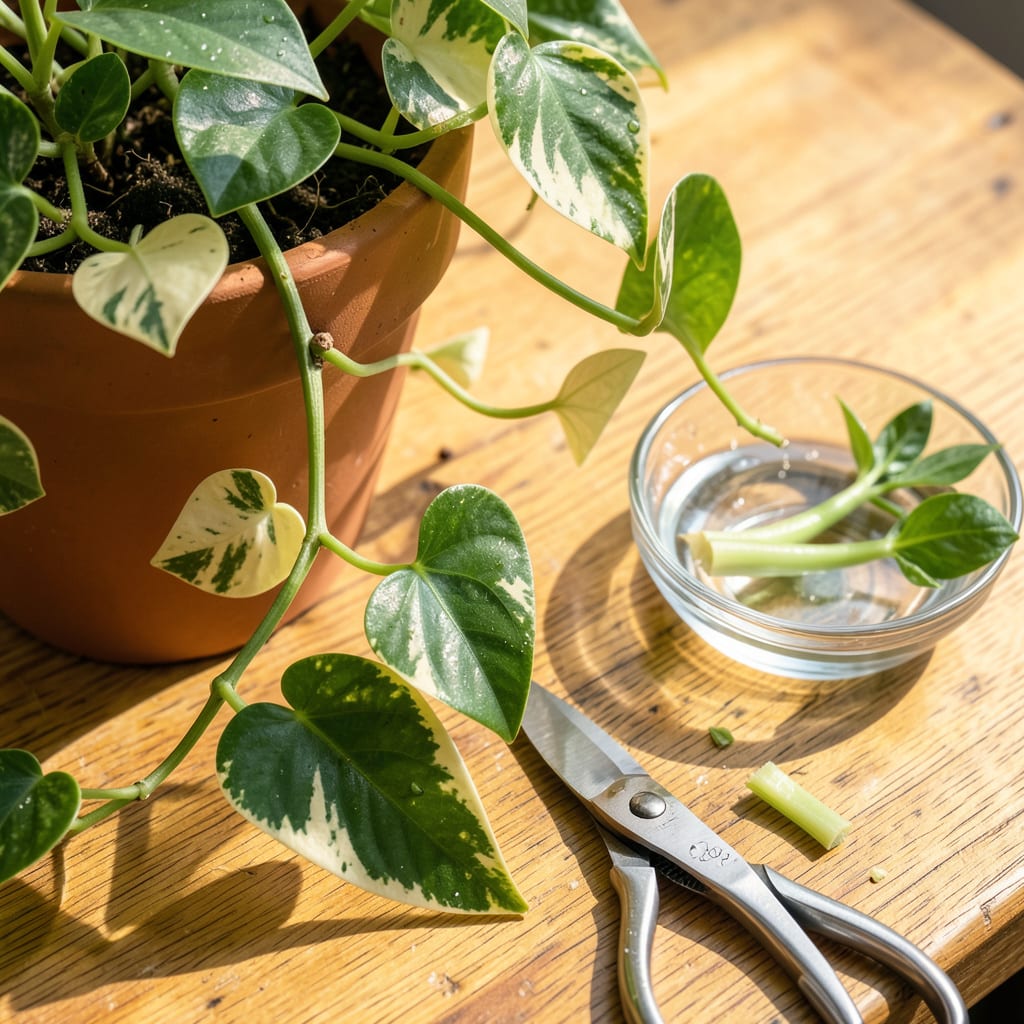
I used to let my pothos grow wild—until I realized pruning was the missing link to those lush, full vines I envied. A few strategic cuts transformed my leggy plants into thick, vibrant cascades that grow twice as fast as before. The best part? Those trimmings become free baby plants.
Timing matters more than you’d think. Prune in spring or early summer when growth is active, and your pothos will reward you with bushier vines in weeks. No fancy tools needed—just clean scissors and 10 minutes. Here’s exactly where to cut and why it works.
📚 In This Guide
This simple method will transform your pothos into a bushier, healthier plant in just minutes.
Look for the leaf nodes—those small brown bumps where leaves grow from the stem. These are your pruning targets. I always cut just above a node (about ¼ inch above) because that’s where new growth will sprout. Never leave a long bare stem below your cut, as this creates weak growth points.
Focus on long, leggy vines first. If a vine has 6+ inches of bare stem between leaves, it’s ready for pruning. You’ll notice the plant naturally directs energy to these cuts, creating that fuller look we want. Don’t worry about overdoing it—pothos are incredibly resilient.
Use sharp scissors or pruning shears (dull blades crush stems). Angle your cut at about 45 degrees with the higher side facing outward. This prevents water from pooling on the cut surface, which could lead to rot. I like to make my cuts in one smooth motion—no sawing back and forth.
You’ll feel a slight resistance as you cut through the stem, then a clean release. If the stem flattens or frays, your tools need sharpening. After each cut, step back and check the plant’s shape. We’re going for balanced fullness, not random chopping.
Remove about one-third of the vine length at a time. This might seem aggressive, but pothos respond by pushing out multiple new shoots from each cut node. I always prune the longest vines first, working my way toward the center. You’ll see the plant’s natural symmetry emerge as you go.
For trailing pothos, cut just above where you want new growth to begin. If you’re training it to climb, prune the tips to encourage side shoots that will fill in the support structure. Within 2-3 weeks, you’ll notice tiny new leaves forming at each cut point—that’s your sign it’s working.
Don’t discard those cuttings! Each piece with 2-3 leaves and a node can become a new plant. I place mine in water immediately after pruning—you’ll see roots forming in 7-10 days. Change the water every 3-4 days to prevent bacterial growth.
Once roots reach 1-2 inches long, you can pot them up. This is the fastest way I know to multiply your pothos collection. The original plant benefits from pruning, and you get free new plants—it’s the ultimate win-win in houseplant care.
Pruning pothos doesn’t have to be intimidating—these practical insights will help you achieve that lush, full look you’re after while avoiding common pitfalls.
Node Identification: In Step 1, don’t just look for the brown bumps—feel them too. A healthy node will be slightly raised and firm to the touch. I’ve found that running my fingers along the stem helps locate nodes more accurately than visual inspection alone, especially on mature vines where nodes might be less obvious. The ¼ inch distance above the node is crucial; any closer and you risk damaging the growth point, any farther and you leave unnecessary bare stem.
Tool Sharpness Matters: For Step 2, here’s what nobody tells you—dull scissors don’t just make messy cuts, they actually stress the plant. I test my tools by cutting a piece of paper first; if it doesn’t slice cleanly, sharpen your scissors. The 45-degree angle isn’t just for aesthetics; it creates more surface area for new growth to emerge while preventing water accumulation that could lead to stem rot.
Pruning Strategy: When following Step 3’s one-third rule, I use this trick: hold the vine along a ruler or straight edge to visualize exactly where to cut. This prevents the “oops, I took off too much” moment. Remember that pothos grow from the node closest to the cut, so strategic cuts will determine where your plant fills out. For trailing plants, I make my first cut where I want the cascade to begin, then work upward.
Propagation Pro Tip: In Step 4, don’t let your cuttings sit out before putting them in water. I keep a small bowl of water right next to me while pruning and place cuttings immediately. The 7-10 day rooting period starts faster when the cut stem doesn’t have time to dry out. Change the water every 3-4 days without fail—this is when most people lose cuttings to bacteria. I use room temperature water and clear containers to monitor root development easily.
Prune pothos in spring or early summer for best results—this is when growth is most active! Winter pruning won’t harm the plant, but new growth may be slower. If your pothos is overgrown or leggy, a light trim anytime is fine—just avoid heavy pruning in dormancy.
Pruning removes unwanted growth to shape or rejuvenate the plant, while propagating uses cuttings to grow new plants. You can do both at once! Snip healthy stems just below a node for propagation, and trim leggy or yellowing vines for pruning. Win-win!
Don’t panic! Temporary sparseness is normal. Pothos bounce back fast—new growth will sprout near the cuts in 2–4 weeks. To speed it up, ensure bright, indirect light and water when the top inch of soil is dry. Avoid over-pruning (never remove more than ⅓ of the plant at once).
For clean cuts, sharp pruning shears or scissors (wiped with rubbing alcohol) are best—they prevent crushing stems. Pinching works for soft new growth but can leave jagged edges. Always cut ¼ inch above a leaf node to encourage bushier regrowth.
Leggy pothos need a “haircut”! Trim back long vines just above a leaf node to promote branching. Rotate the pot regularly for even light exposure, and consider pinching tips of new growth to redirect energy. Fertilize monthly in growing season for extra fullness.
