
Beautiful Plants For Your Interior
Beautiful Plants For Your Interior
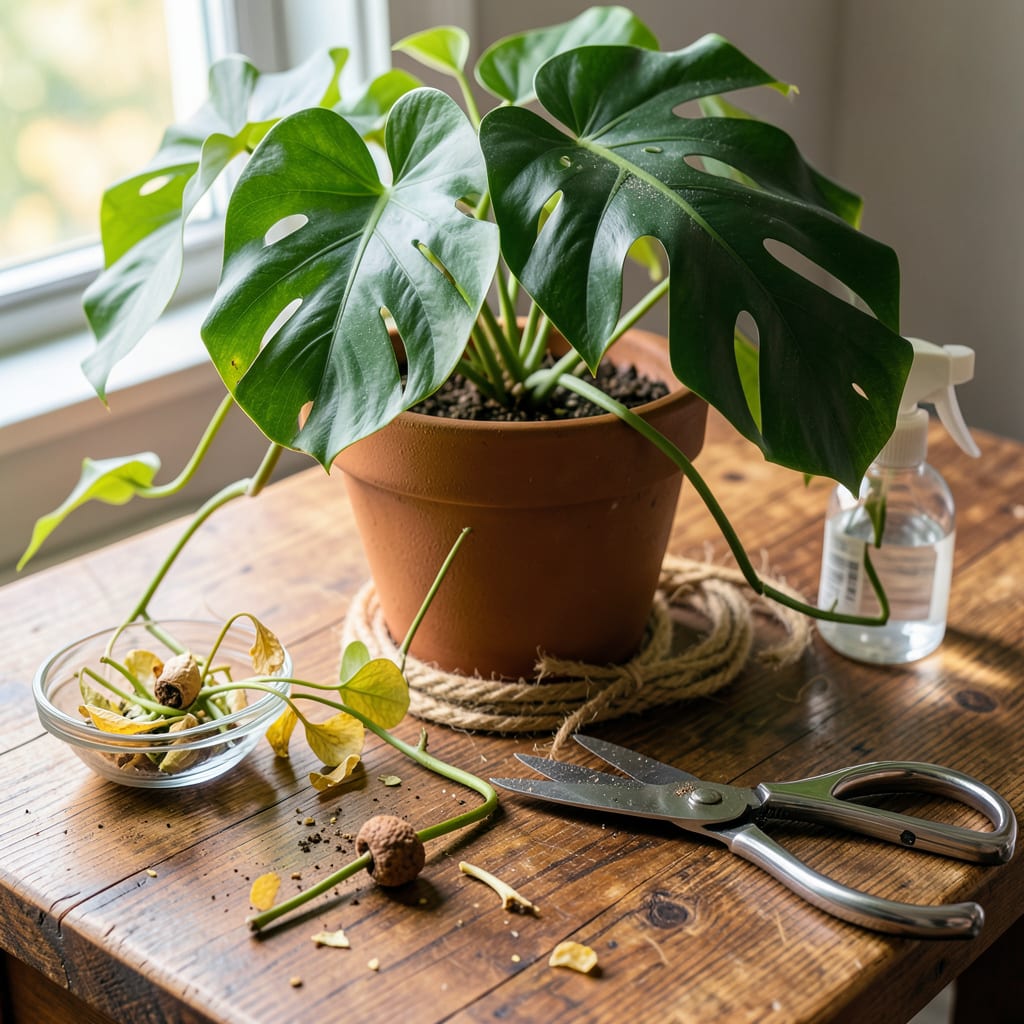
That first time I pruned my Monstera, I nearly chickened out. The plant was leggy, leaves were small, and I worried I’d ruin it. Turns out, strategic cuts were exactly what it needed to transform into the lush, statement-making plant it is today.
Pruning isn’t just about size control—it’s how you get those giant, fenestrated leaves everyone wants. The right cuts redirect energy to new growth, and within weeks, you’ll see fresh shoots emerging exactly where you want them. No fancy tools required, just clean shears and a little confidence.
📚 In This Guide
This simple process will transform your plant—promoting bushier growth and those dramatic fenestrated leaves we all love.
Start by examining your monstera for yellowing leaves, damaged foliage, or overly long vines with sparse leaves. These are your primary targets. I always look for nodes (those little brown bumps on the stem) because that’s where new growth will emerge after pruning.
For a fuller plant, focus on vines that have grown 3-4 feet long with large gaps between leaves. You’ll want to cut just above a node—about ¼ inch above it—so the plant can push out new growth from that point. Never cut a stem without at least one healthy leaf remaining below your cut.
Using sharp, clean pruning shears (I wipe mine with rubbing alcohol first), make a 45-degree angled cut just above your chosen node. This angle prevents water from pooling on the cut surface, which could lead to rot. A clean cut heals faster than a jagged one.
If you’re removing an entire vine, cut it back to the main stem. For leaf removal, cut as close to the main stem as possible without damaging it. You’ll feel a slight resistance when cutting through the stem—that’s normal. Don’t force it; let the shears do the work.
Don’t discard those cuttings! Healthy stems with at least one node and one leaf can be propagated. I place mine in water immediately, ensuring the node is submerged but the leaf stays dry. You’ll see roots forming in 2-3 weeks if kept in bright, indirect light.
For larger cuttings, you can plant them directly in soil. Dip the cut end in rooting hormone first if you have it, then plant in moist potting mix. Keep the soil consistently damp (but not soggy) until new growth appears, which usually takes 4-6 weeks.
After pruning, your monstera will need extra care to recover. Move it to a spot with bright, indirect light (no direct sun) and maintain consistent moisture. I water mine when the top 1-2 inches of soil feel dry, usually every 7-10 days depending on your home’s humidity.
You’ll notice new growth emerging from the nodes below your cuts within 3-4 weeks. This is when the magic happens—the plant will push out multiple new stems from each cut point, creating that full, bushy look. Rotate your plant occasionally so all sides get equal light exposure.
Pruning isn’t a one-time task. I check my monstera every 2-3 months for new long vines or damaged leaves. Regular maintenance keeps the plant looking its best and prevents it from becoming leggy. Each time you prune, you’re training the plant to grow in a specific shape.
Don’t be afraid to prune aggressively—monsteras are tough and bounce back quickly. The more you prune, the fuller your plant will become. I’ve found that plants pruned regularly produce larger leaves with more dramatic fenestrations (those beautiful splits and holes) than neglected ones.
Pruning your monstera doesn’t have to be intimidating—these practical insights will help you avoid common pitfalls and get the best results.
Node Identification: In Step 1, don’t overlook those small brown nodes—they’re the key to successful pruning and propagation. I’ve found that using a magnifying glass helps spot them on older, woodier stems where they might be less obvious. Remember, each node is a potential growth point, so cutting just ¼ inch above it (as mentioned in the instructions) gives your plant the best chance to branch out.
Tool Preparation: Before making any cuts in Step 2, take a moment to properly clean your pruning shears. I learned the hard way that even invisible bacteria can transfer between plants. A quick wipe with rubbing alcohol not only prevents disease but also helps make cleaner cuts. Dull blades crush stems rather than cutting them—sharp shears make that 45-degree angle much easier to achieve.
Propagation Timing: When managing cuttings in Step 3, timing matters more than you might think. The 2-3 weeks mentioned for root development in water isn’t just a suggestion—it’s the sweet spot. I’ve noticed that changing the water every 5-7 days during this period prevents bacterial growth and speeds up root formation. For soil propagation, maintaining that consistently damp (but not soggy) condition for 4-6 weeks is crucial for success.
Post-Pruning Care: After pruning in Step 4, many people overlook the importance of stability. Your monstera might feel top-heavy after removing long vines. I recommend adding a support stake if needed, especially for larger plants. The 3-4 weeks mentioned for new growth to appear is accurate, but you’ll see the fastest results if you maintain that 1-2 inches of dry soil between waterings—this encourages the plant to focus energy on new shoots rather than maintaining excess foliage.
The ideal time is early spring to late summer (growing season), when your Monstera is actively producing new leaves. Avoid pruning in winter—slow growth makes recovery harder. Light pruning for damaged leaves can be done year-round, though!
Hold off on heavy pruning for young or small Monsteras (under 1–2 feet tall). Focus on removing only dead or yellowing leaves to avoid stunting growth. Once mature (3+ leaves), you can shape it confidently. Patience pays off!
Pruning removes leaves/stems to improve plant health or shape, while propagating uses cuttings to grow new plants. You can do both at once! Just ensure your cuttings have at least one node (bump where roots grow) for propagation success.
Over-pruning (removing >30% of foliage at once) or using dirty tools can shock your plant. Check for:
Staking (with a moss pole or trellis) supports growth but doesn’t replace pruning. Overgrown vines can block light, reduce air circulation, or split pots. Combine both: stake for height, prune to encourage bushiness and remove leggy growth. Win-win!
