
Beautiful Plants For Your Interior
Beautiful Plants For Your Interior
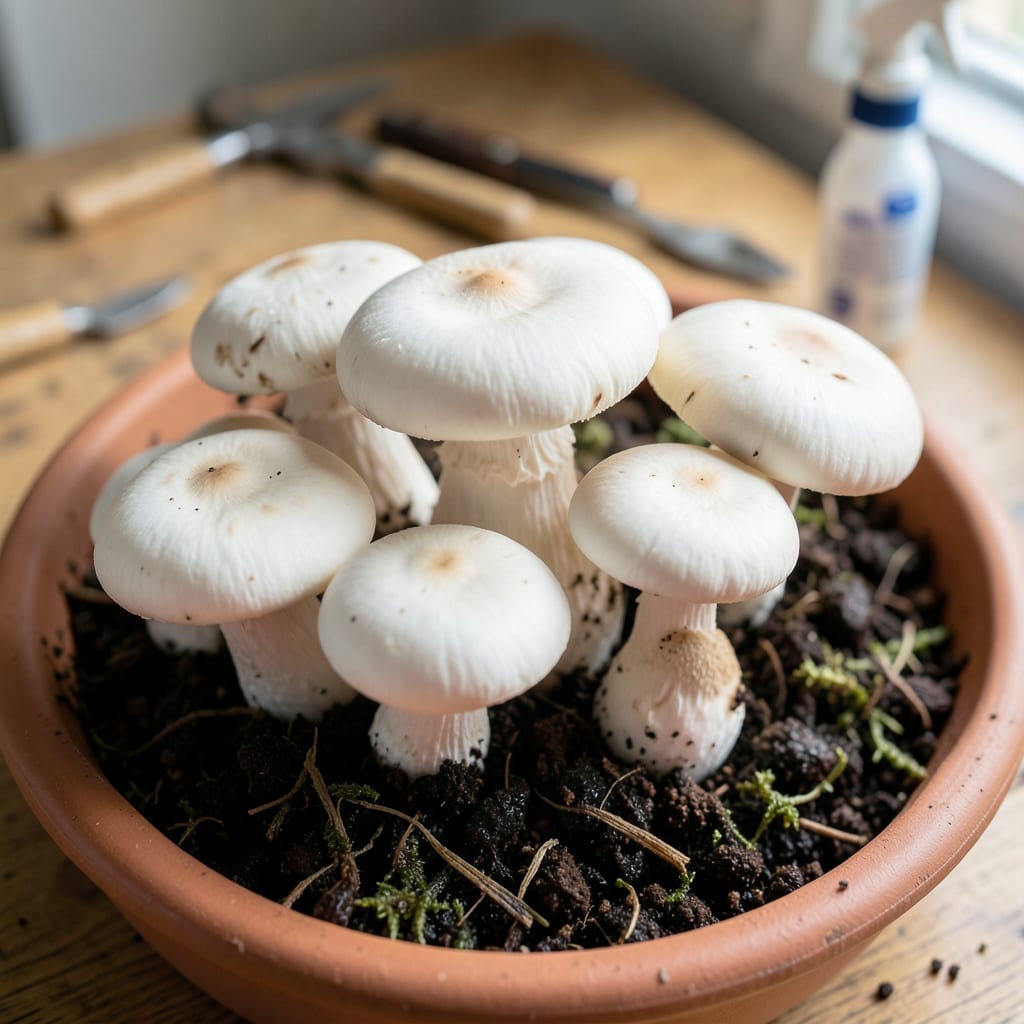
Mushrooms typically take 3 to 6 weeks to grow from spawn to harvest, depending on the variety. Oyster mushrooms may fruit in as little as 2 weeks, while shiitake can take 6 to 12 months when grown on logs.
This wide range comes down to the growing method and mushroom species. 🌱 Fast-growing varieties like oysters thrive on straw or sawdust substrates, while log-grown shiitakes require months for mycelium to fully colonize the wood. I’ve found that temperature and humidity play huge roles too—keeping conditions steady can shave days off your timeline. The key is understanding whether you’re dealing with a quick-turnaround variety or a slow-but-worth-it investment like wine cap mushrooms.
💡 In This Article
The time it takes to grow mushrooms depends heavily on the substrate you choose. Straw-based substrates (like those used for oysters) colonize in just 7-14 days because the mycelium can spread quickly through the loose material. Hardwood sawdust takes longer—about 2-4 weeks—while logs (common for shiitake) may require 6-18 months for full colonization.
The density of the material directly impacts how fast the mycelium can break it down and establish itself. 🔥
Temperature and humidity are the silent accelerators (or brakes) of mushroom growth. Most varieties thrive at 70-75°F with 80-90% humidity during colonization. Oyster mushrooms, for example, can double their growth speed in these conditions, while shiitakes prefer slightly cooler temps (60-65°F). Even a 5°F drop can add days to your timeline.
Humidity below 70% causes dry, cracked caps, while excess moisture invites contamination. ✨
Each mushroom species has its own biological clock. Button mushrooms (Agaricus bisporus) typically take 3-4 weeks from spawn to harvest, while wine caps (Stropharia rugosoannulata) need 4-6 weeks in ideal conditions. The real outlier is shiitake—log cultivation forces the mycelium to work harder, extending the process to 6-12 months before first flush.
This slow growth actually develops deeper umami flavors in the final product. 💫
The growth process happens in distinct phases, each with its own timeline. Inoculation to colonization (when mycelium spreads through the substrate) takes 1-4 weeks depending on the material. Pinning (when tiny mushrooms form) occurs 3-7 days after introducing fresh air and light.
The fruiting phase—where mushrooms grow to harvest size—typically lasts 5-10 days for fast growers like oysters, but can stretch to 2 weeks for denser varieties like portobello. ⚡
Here’s what most beginners overlook: the spawn run (initial colonization) accounts for 60-80% of the total time. Rushing this phase by increasing temperature often backfires, creating weak mycelium that’s prone to contamination. I’ve seen growers cut 2 weeks off their timeline by maintaining perfect conditions during this critical window. The secret?
Patience during colonization, then aggressive fresh air exchange during fruiting. 🌟
Consider these real-world examples of how substrates affect timelines:
Light exposure plays a surprising role too. While mushrooms don’t photosynthesize, 12 hours of indirect light daily triggers pinning in most species. Oysters will fruit with just 6 hours, but shiitakes require 8-12 hours for optimal development.
The wavelength matters—blue light spectrums (like from LED grow lights) can reduce pinning time by up to 2 days compared to natural light. 💛
Contamination is the silent timeline killer. A single bacterial or mold spore can set you back 2-3 weeks as you sterilize and restart. Professional growers use HEPA filters and positive pressure systems to maintain 99.9% clean air.
For home growers, simple tricks like wiping down surfaces with 70% isopropyl alcohol and using a 0.2 micron filter on your fruiting chamber can prevent most issues. I’ve rescued contaminated batches by isolating healthy mycelium and transferring it to fresh substrate—saving 1-2 weeks versus starting over. 🌟
The water content of your substrate makes or breaks your timeline. Straw should be at 65-75% moisture—squeeze a handful and you should get 2-3 drops of water. Sawdust needs 50-60% moisture to prevent compaction. Logs for shiitake must be 30-40% moisture when inoculated. Too wet? Mycelium drowns. Too dry? Growth stalls.
The sweet spot accelerates colonization by up to 30%. Pro tip: Use a moisture meter—they’re $20 and save weeks of guesswork. ⚡
Oyster mushrooms are your best bet—they can fruit in as little as 2 weeks under ideal conditions. Their aggressive mycelium colonizes straw or sawdust substrates quickly, and they’re more forgiving of minor environmental fluctuations than other varieties.
This usually indicates suboptimal conditions. Check your temperature (70-75°F ideal) and humidity (80-90% during colonization). If those are correct, contamination might be slowing growth—look for unusual colors or smells. A 70% alcohol spray can often rescue stalled kits.
Most substrates support 2-3 flushes. After harvesting, soak the block in cold water for 12 hours, then return to fruiting conditions. Each subsequent flush may take 7-10 days longer than the previous one as nutrients deplete.
For oysters, harvest when caps fully open but edges remain slightly curled (5-7 days after pinning). Shiitakes are ready when caps are 70-90% open. Always use a clean knife to cut at the base—never pull, as this damages the mycelium for future flushes.
Invest in a $35 temperature controller and $10 hygrometer. These tools let you maintain perfect conditions (72°F, 85% humidity) automatically. I’ve cut 3-5 days off grow times using these—far cheaper than losing batches to poor environment control.
