
Beautiful Plants For Your Interior
Beautiful Plants For Your Interior
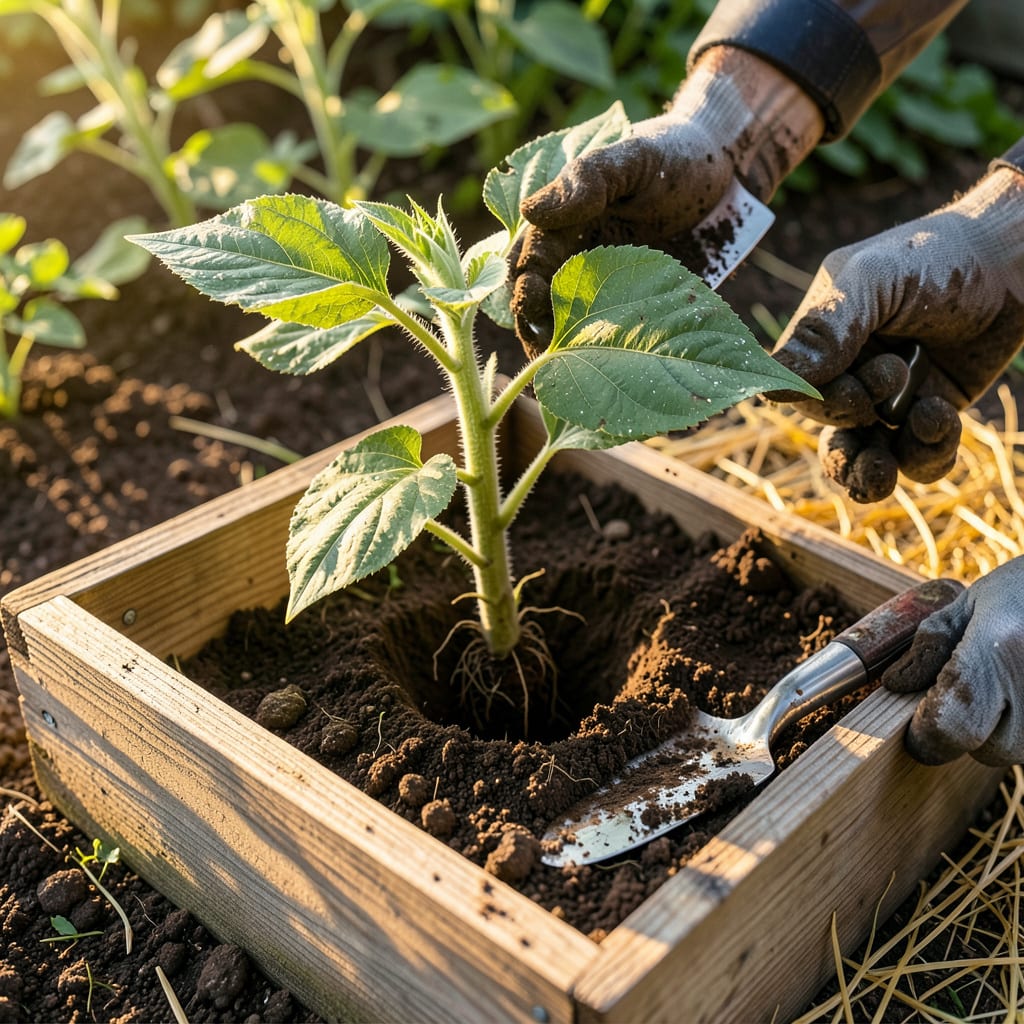
Sunflowers don’t just stand tall—they demand the right foundation. After years of watching seedlings flop or stunt from poor transplanting, I’ve nailed the depth that turns spindly stems into unshakable giants. The secret isn’t complicated: it’s about matching the hole to the roots, not the seedling’s height.
You’ll want to bury them deeper than you think—right up to the first true leaves—but giant varieties need 18-24 inches of prepared soil below, while dwarfs thrive with half that. Get this right, and you’ll see roots anchor fast, stems thicken within days, and flowers that laugh at windstorms. Here’s exactly how to dig that perfect hole.
📚 In This Guide
Here’s the method I’ve perfected over seasons—your sunflowers will establish faster with roots that anchor like steel cables.
Choose a location with full sun exposure (minimum 6-8 hours daily) and well-draining soil. I always transplant in late afternoon or on a cloudy day to minimize shock—direct sun on fresh transplants causes immediate wilting. Test soil moisture by digging 4 inches deep; it should crumble easily but hold shape when squeezed.
Work the soil to a depth of 12-15 inches, removing rocks and breaking up clumps. Sunflower roots grow rapidly, and compacted soil stunts their vertical taproot development. If your native soil is heavy clay, amend with compost to improve drainage—waterlogged roots rot within 48 hours.
The hole should be twice as wide as the root ball and 1-2 inches deeper than the container depth. For standard 4-inch pots, this means a 6-inch deep hole. The extra depth accommodates the taproot’s downward growth while preventing stem burial, which causes collar rot.
Create a slight mound of soil at the hole’s center where the root ball will sit. This elevation ensures the stem remains 1/2 inch above the surrounding soil line after settling. I use my trowel handle to measure—place it horizontally across the hole; the stem base should sit just below the handle’s top edge.
Gently squeeze the container sides to loosen the root ball, then invert it into your hand. Never pull by the stem—sunflower stems snap easily at the soil line. If roots are circling, make three vertical cuts down the root ball sides with clean shears to encourage outward growth.
Place the seedling on the mound, spreading roots downward. The ideal depth shows the first set of true leaves sitting 2-3 inches above soil level. Backfill with native soil, pressing gently to eliminate air pockets. Water immediately with 1 pint of solution (I use kelp extract at half strength) to reduce transplant shock.
Create a 3-inch high soil berm around the hole’s perimeter to act as a water basin. This directs moisture to the root zone during the critical first 10 days. Insert a 3-foot bamboo stake 2 inches from the stem and tie loosely with soft twine—sunflowers grow toward light, and unstaked plants develop permanent leans.
Apply 2 inches of organic mulch (straw or shredded leaves) around the plant, keeping it 1 inch away from the stem. Mulch maintains even soil temperature and moisture, which is crucial while the taproot establishes. You’ll know the transplant has succeeded when new leaves appear within 5-7 days.
Check soil moisture daily at 2-inch depth—it should feel like a wrung-out sponge. Overwatering is more dangerous than underwatering at this stage; soggy soil causes stem rot that’s irreversible. If leaves wilt by midday but recover by evening, increase water slightly. Permanent wilting means root damage.
Watch for wind rock—the stem should remain perfectly vertical. If you see movement, add a second stake. The taproot anchors fully by day 14, at which point you’ll observe rapid upward growth. Remove any yellowing lower leaves immediately; they’re normal but can harbor fungal spores in humid conditions.
After years of trial and error with sunflower transplants, these are the details that make all the difference between a struggling plant and one that thrives.
Timing Secret: The 6-8 hours of daily sun requirement in Step 1 isn’t just a suggestion—sunflowers need this intensity to develop strong stems. I’ve found that afternoon sun (after 2 PM) is particularly valuable because it coincides with their natural growth rhythms. If your location gets intense midday sun, consider using shade cloth for the first 48 hours to prevent leaf scorch while roots establish.
Depth Precision: When digging that 6-inch hole in Step 2 for your 4-inch pots, here’s what nobody tells you—the extra 2 inches aren’t just for the taproot. That buffer zone prevents what I call “stem suffocation,” where settling soil gradually buries the base. I always place a ruler across the hole to verify the stem will sit exactly 1/2 inch above the surrounding soil line after backfilling. This single measurement prevents more transplant failures than any other step.
Root Preparation Technique: The three vertical cuts mentioned in Step 3 might seem aggressive, but they’re crucial for preventing what I call “toilet bowl roots”—where roots keep circling instead of growing outward. Make these cuts exactly 1/4 inch deep into the root ball, spaced evenly around the circumference. I use sterilized scissors (dipped in rubbing alcohol) to prevent introducing pathogens. This encourages the roots to branch horizontally, creating that steel-cable anchorage mentioned in the instructions.
Critical First 10 Days: That 3-inch soil berm you create in Step 4 isn’t just about water—it’s your early warning system. If the berm empties within 12 hours, you’re underwatering. If water pools for more than 24 hours, you’ve overdone it. I check mine at 8 AM and 6 PM daily during this period. The berm should be moist but not soggy at 2-inch depth, exactly as specified in Step 5. This is when 90% of transplant failures occur, usually from overenthusiastic watering.
For most sunflower varieties, dig a hole 12–18 inches deep and slightly wider than the root ball. Dwarf types need only 6–10 inches. Ensure the hole accommodates the entire root system without bending. Pro tip: Loosen the soil at the bottom for easier root expansion!
Avoid extreme heat! Early morning or late afternoon is best. If transplanting in summer, water deeply before and after moving the plant. Use shade cloth for 2–3 days to reduce stress. Aim for mild weather (60–75°F) for the smoothest transition.
Gently trim the longest roots (up to ⅓ of the length) with clean shears—this encourages branching. Avoid cutting the main taproot. If roots are circling (potted plants), tease them apart before planting to prevent girdling.
Direct-sowing is ideal (sunflowers dislike root disturbance!). But if you must transplant (e.g., starting indoors), use biodegradable pots to minimize shock. Seedlings transplant best at 2–3 inches tall with 2–4 true leaves.
Common causes: underwatering, transplant shock, or root damage. Water deeply (1–2 inches/week) and add a dilute fertilizer (5-10-5) after 1 week. If wilting persists, check for pests or stem rot. Most plants recover in 3–7 days with proper care!
