
Beautiful Plants For Your Interior
Beautiful Plants For Your Interior
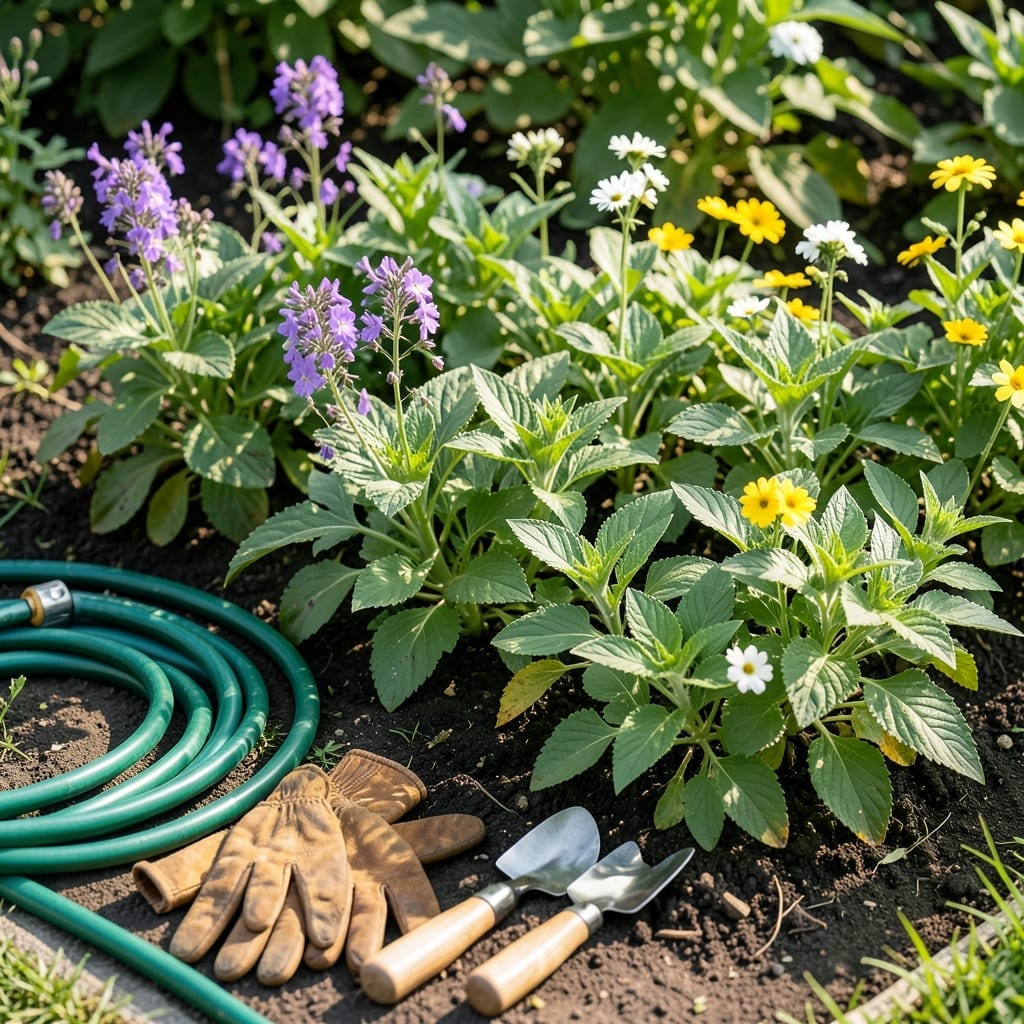
Measure the length and width of your garden space in feet, then multiply them together. For irregular shapes, divide into smaller rectangles and add their areas for the total.
I always start by sketching my plot to visualize the space. This helps me spot irregular sections that need breaking down into manageable shapes. Knowing the exact square footage lets me plan plant spacing and material quantities with precision. It’s surprising how much difference accurate measurements make in garden layout. ✨
For circular or triangular areas, I use the appropriate geometric formulas to ensure accuracy in my calculations.
💡 In This Article
Rectangular gardens use the simplest formula: length multiplied by width. For example, a 20-foot by 30-foot plot gives you 600 square feet. This is the foundation for most garden calculations and works for raised beds or in-ground layouts.
Circular gardens require the formula πr², where r is the radius. A garden with a 10-foot radius has an area of about 314 square feet. For precision, use 3.1416 for π to account for every inch of planting space. 🔥
Triangular plots use ½ base × height. If your garden tapers to a point, measure the longest side as the base and the perpendicular distance as the height. A triangle with a 15-foot base and 10-foot height covers 75 square feet. ✨
For irregular shapes, break the area into rectangles and triangles. Measure each section separately, calculate their individual areas, then sum them. This method works even for L-shaped or freeform gardens.
Always double-check measurements with a second pass. Small errors in length or width can compound significantly in the final area calculation, especially for larger plots.
Use a laser measure for accuracy on uneven terrain. This tool helps maintain straight lines and precise distances, which is critical for gardens on slopes or with curved edges. 💫
A 100-foot tape measure works for most plots. For large or irregular spaces, use a laser measure for accuracy. Always have a notepad to record dimensions and a calculator for quick area computations.
Divide it into rectangles. Measure each section separately, calculate their individual areas, then add them together. For example, a 10×12-foot section plus a 6×8-foot section equals 168 square feet total.
It helps you buy the right amount of soil, mulch, or plants. You’ll avoid over- or under-purchasing materials, saving money and reducing waste. Precise measurements also ensure proper plant spacing for healthy growth.
Yes! Apps like MagicPlan or Garden Planner let you map your space and compute area automatically. They’re great for irregular shapes but always verify with manual measurements for accuracy.