
Beautiful Plants For Your Interior
Beautiful Plants For Your Interior
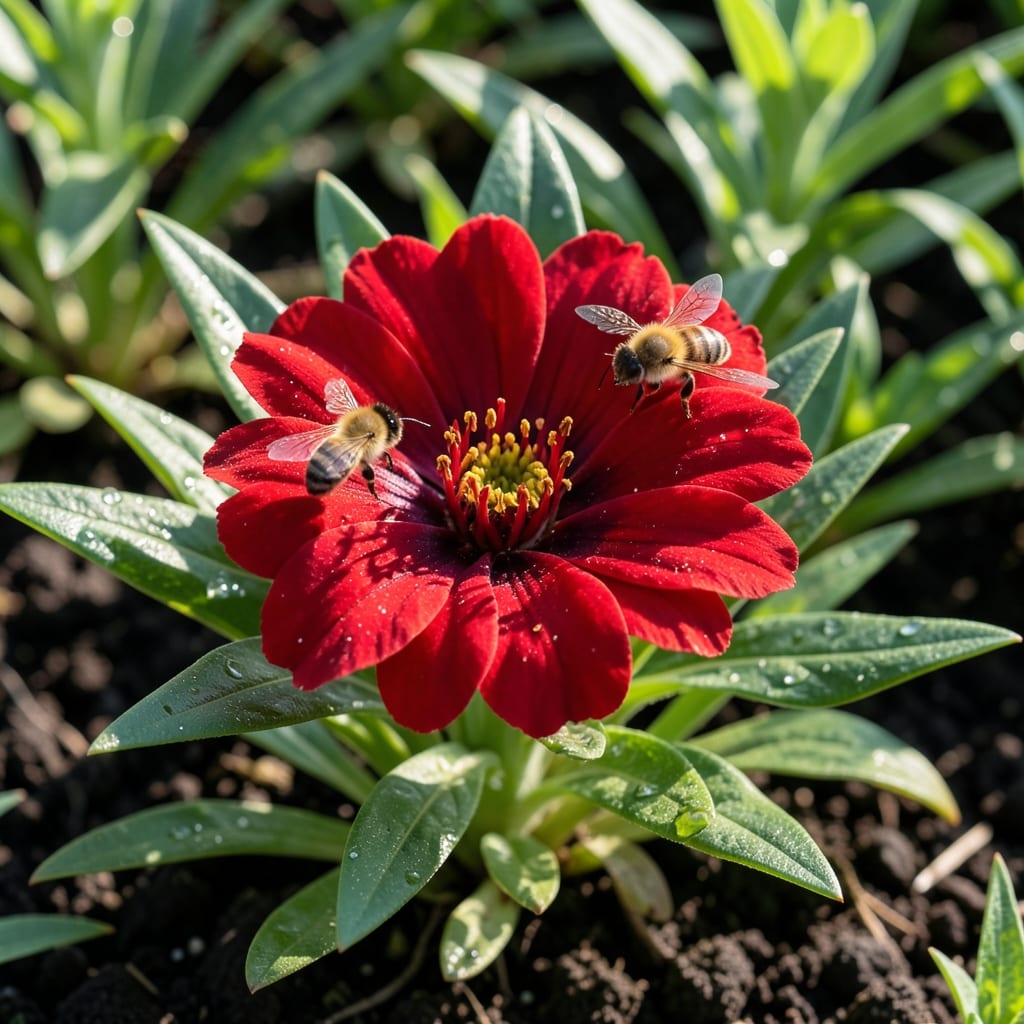
Bees are not naturally attracted to red because their vision is optimized for ultraviolet, blue, and yellow wavelengths, making red appear as a dark, uninteresting color to them.
I discovered this happens because bee eyes have specialized receptors for ultraviolet light and shorter wavelengths. Unlike humans, they see red flowers as nearly black, which is why they often ignore them in favor of brighter hues. This evolutionary adaptation helps them zero in on the most nectar-rich blooms efficiently. ✨
💡 In This Article
Bees see the world through a completely different color spectrum than we do. Their compound eyes contain photoreceptors sensitive to ultraviolet light (wavelengths 300-400 nm), blue, and yellow, but lack the red receptor humans possess.
This means they perceive colors in a range we can’t even imagine, with UV patterns often visible on flowers that appear plain white to us. 🔥
When bees look at a red flower, they’re essentially seeing darkness. The long wavelengths of red light (620-750 nm) fall outside their visible range, making red blooms appear as dull, unappealing blobs.
This isn’t a limitation but an evolutionary advantage—it helps them focus on the most nectar-rich flowers that typically bloom in blues, purples, and yellows. ✨
This color perception directly influences their foraging behavior. Studies show bees can distinguish between colors separated by just 10-20 nm in wavelength, an ability far surpassing human color discrimination. They’re particularly drawn to colors that reflect UV light, which often signals high nectar content.
The red poppy you admire might as well be invisible to a foraging bee. 💫
What’s fascinating is how some red flowers have adapted to this. Many develop UV patterns or produce strong fragrances to attract bees despite their color handicap. This evolutionary dance between flowers and pollinators demonstrates how color vision shapes entire ecosystems.
The next time you see a bee ignoring red flowers, you’ll know it’s not disinterest—it’s literally out of sight. ⚡
For comparison, humans see colors from about 400-700 nm, with our red perception being strongest around 650 nm. Bees’ vision cuts off around 550 nm, which is why greens appear as their “red.” This fundamental difference explains why bee-friendly gardens focus on blues, purples, and yellows rather than reds. 🌟
Red appears nearly black to bees since their vision doesn’t include the red spectrum. Their eyes are tuned to ultraviolet, blue, and yellow wavelengths, making red blooms invisible or dull to them.
Bees are drawn to purple, blue, yellow, and white flowers. These colors signal nectar-rich sources and fall within their visible range. Planting clusters of these hues creates a beacon for foraging bees.
Some red flowers produce UV patterns or strong fragrances to compensate. While the color itself isn’t appealing, these adaptations can still lure bees in despite their red appearance.
Focus on planting groups of 3-5 flowers in bee-preferred colors. Choose flat or shallow blooms like daisies for easy nectar access, and avoid deep, tubular flowers.