
Beautiful Plants For Your Interior
Beautiful Plants For Your Interior
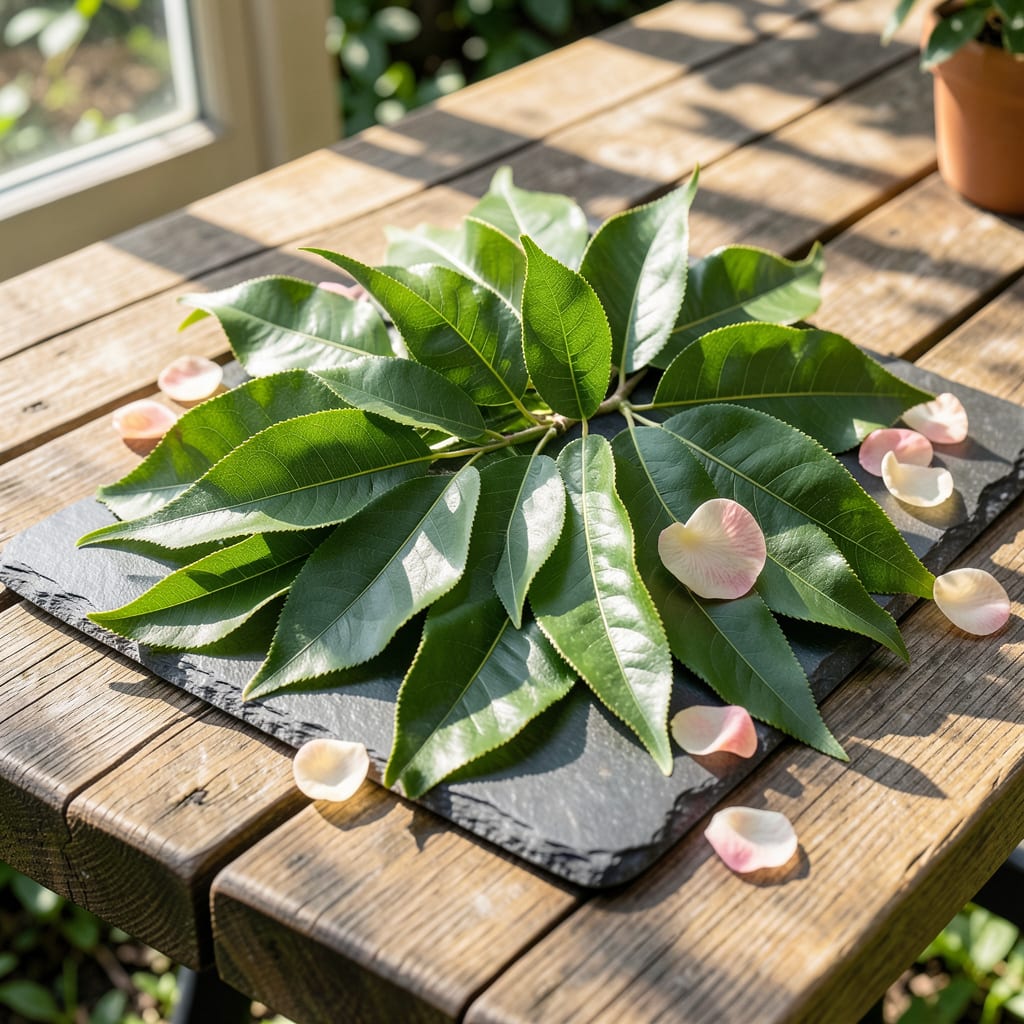
Those delicate, lance-shaped leaves should be a vibrant green, but when they start curling or spotting, your peach tree is crying for help.
I’ve learned the hard way that early diagnosis saves trees. Yellowing, holes, or sticky residue each point to different issues—most are fixable with the right approach. Healthy foliage means a productive tree next season.
📚 In This Guide
Here’s the method I use to spot healthy growth and keep peach foliage thriving through every season.
Peach tree leaves appear as lance-shaped with finely serrated edges, growing 3-6 inches long and 1-2 inches wide. The upper surface should be a vibrant medium to dark green, while the underside often carries a slightly paler tone. I always check for this color contrast first—it’s the clearest sign of vigor.
New growth emerges with a subtle reddish tint that matures to green within 7-10 days. If leaves stay red or purple beyond this period, the tree likely needs more nitrogen or phosphorus. The texture should feel smooth with a slight waxy sheen, not rough or brittle to the touch.
Watch for yellowing between veins (chlorosis), which signals iron deficiency in our alkaline soils. I’ve found this appears first on younger leaves. Brown spots with yellow halos often indicate fungal infections like peach leaf curl, especially after wet springs.
Curling leaves usually mean pest pressure—aphids cluster on new growth, causing distortion. Check the undersides weekly during spring flush. If you see webbing between leaves, spider mites have moved in, and they’ll drain foliage of moisture faster than you’d expect.
Peach trees require full sun (at least 6-8 hours daily) to develop that rich green coloration. In partial shade, leaves grow larger but thinner, with weaker stems that snap in wind. I position mine where morning sun dries dew quickly—this alone prevents most fungal issues.
Soil should drain well while retaining moisture. The ideal pH sits between 6.0-6.5. When leaves show interveinal yellowing, I apply chelated iron within 24 hours to prevent permanent damage. Mulch with 2-3 inches of organic matter to maintain consistent soil temperature and moisture.
In early spring, just as buds swell, I apply a balanced fertilizer to support the first leaf flush. Peach trees push out new growth in two major waves—spring and late summer. The spring leaves are most critical for fruit production, so prioritize their health.
During drought, leaves may wilt slightly by midday but should recover by evening. If wilting persists into morning, deep watering is overdue. I’ve learned that mature trees can survive on 1-2 inches of water weekly, but young trees need 1-2 inches every 3-4 days during establishment.
Thin the canopy in late winter to allow light to reach inner branches. I remove about 20-30% of last year’s growth, focusing on crossing branches and water sprouts. This opens the center so air circulates freely, which keeps leaves dry and disease-free.
After pruning, I always sterilize tools with rubbing alcohol between cuts. Peach trees bleed sap heavily in spring, but this doesn’t harm them—just avoid pruning when leaves are actively growing, as the wounds heal more slowly then. Proper airflow shows in leaves that remain turgid and deep green all season long.
Small adjustments make a big difference in keeping foliage healthy year-round.
The Observation Window: New growth should transition from reddish to green within exactly 7-10 days. If that color change stalls, it’s your tree signaling a nitrogen or phosphorus shortage. I mark my calendar when I spot fresh leaves to track this critical period.
Sunlight Strategy: The 6-8 hours of daily full sun requirement isn’t negotiable for vibrant leaf color. I’ve seen partial shade produce weak, snap-prone stems. Morning sun exposure is particularly valuable—it dries dew quickly, which I’ve found reduces fungal pressure dramatically.
Soil pH Precision: Maintaining that 6.0-6.5 pH range prevents the interveinal yellowing that signals iron deficiency. When I notice this pattern on younger leaves, I apply chelated iron within the specified 24 hours to avoid lasting harm. A soil test kit is worth the small investment.
Watering Wisdom: Mature trees thrive on 1-2 inches of water weekly, but young trees establishing roots need that same amount every 3-4 days. During drought, I watch for midday wilting—if leaves don’t perk up by evening, it’s time for a deep watering session.
Yellow leaves often signal overwatering, poor drainage, or nutrient deficiencies (like nitrogen). Check soil moisture and consider a balanced fertilizer.
Peach trees are deciduous, so leaves naturally drop in fall. If shedding happens in spring/summer, it may indicate stress from pests, disease, or drought.
Yes! Shredded peach leaves decompose well in compost, adding organic matter. Avoid diseased leaves to prevent spreading pathogens.
Curled leaves often mean peach leaf curl fungus. Apply copper fungicide in late winter/early spring, and remove infected leaves promptly.
No—peach leaves contain amygdalin, which can release cyanide in large quantities. Stick to the fruit and avoid consuming the foliage!
