
Beautiful Plants For Your Interior
Beautiful Plants For Your Interior
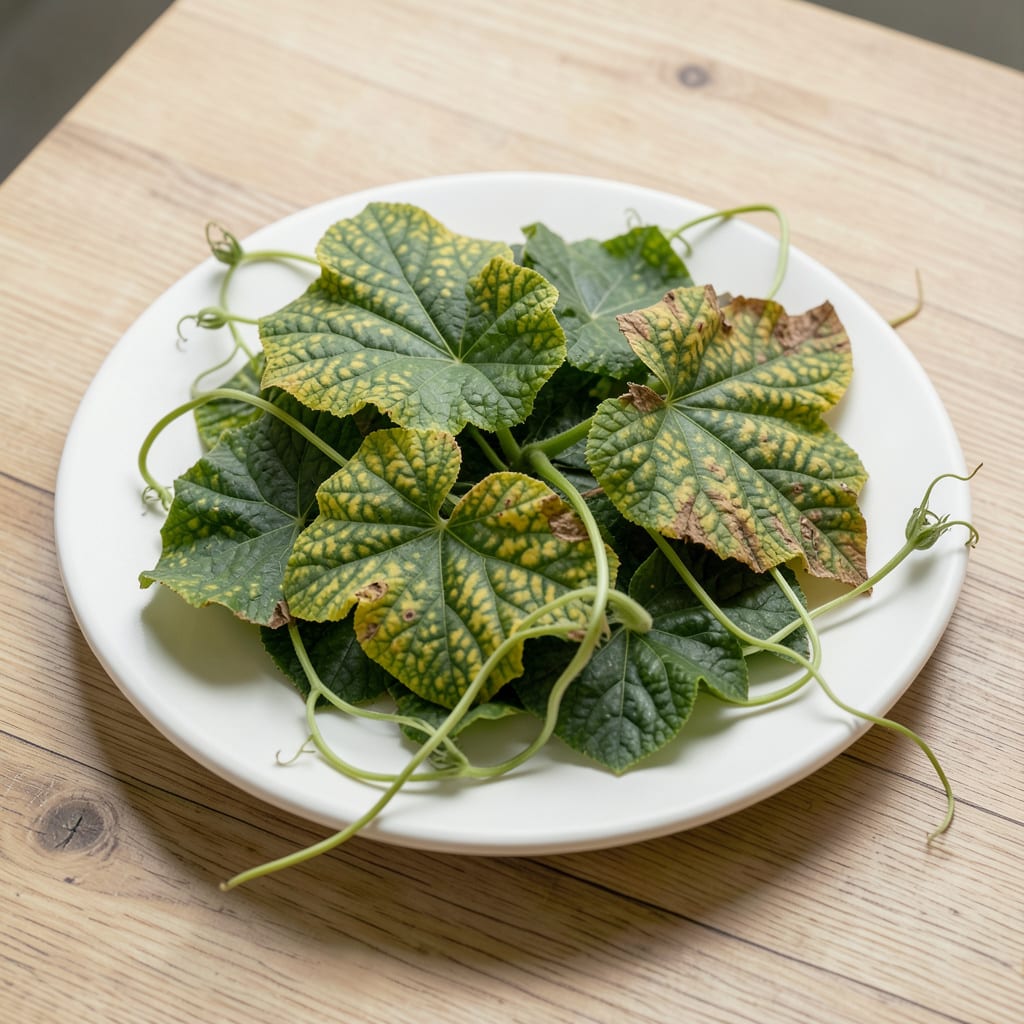
Spotted something off with your cucumbers? The leaves might show mottled yellow-green patterns, like someone splattered paint across them.
This virus stunts growth too—plants stay small, fruits come out bumpy or misshapen. I learned to catch it early by checking for curled leaves and stunted vines first thing in the morning.
📚 In This Guide
Here’s how to spot the telltale signs early and differentiate them from other common plant issues.
Start by inspecting the youngest leaves for mottled yellow and green patches—this is the most characteristic symptom of the virus. The discoloration often appears as a mosaic-like pattern, giving the virus its name. Unlike nutrient deficiencies, which typically affect older leaves first, cucumber mosaic virus targets new growth.
Check both the upper and lower leaf surfaces, as the mottling can be more pronounced on the underside. The yellow areas may feel slightly raised or thicker than the green sections, which is a subtle but reliable indicator.
Next, look for distorted or curled leaves that appear crinkled, narrow, or strap-like. Infected plants often produce leaves that are significantly smaller than healthy foliage. This stunting is a direct result of the virus disrupting normal cell growth and division.
Pay attention to the overall plant size. A cucumber plant affected by the virus will likely be 30-50% smaller than its healthy counterparts at the same growth stage. The internodes (spaces between leaves) may also be noticeably shortened, giving the plant a compact, bushy appearance.
Move your focus to the fruit and flowers. Infected cucumbers often develop misshapen or bumpy fruit with uneven coloring. The skin may show a blotchy pattern of light and dark green, or even white streaks. These fruits are usually smaller and may have a lopsided appearance.
Flowers on infected plants can be malformed or fail to open properly. You might notice green petals or flowers that are smaller than usual. In severe cases, the plant may drop flowers prematurely, leading to a significant reduction in fruit production.
Observe the overall health of the plant. Cucumber mosaic virus often causes a general decline, with symptoms appearing progressively worse over time. Look for wilting during cooler parts of the day, even when soil moisture is adequate. This is unlike drought stress, which typically causes wilting during the hottest part of the day.
Finally, check the stems and veins. Infected plants may exhibit yellowing or necrosis along the veins, particularly on the undersides of leaves. In advanced stages, the entire plant may take on a yellowish or bronze hue, signaling severe infection and reduced vigor.
Small details make all the difference when distinguishing this virus from other plant issues.
The Leaf Inspection Technique: In Step 1, examine both leaf surfaces under good lighting—the mosaic pattern is often more visible on the underside. I’ve found that using a hand lens reveals the raised texture of yellow patches that confirms the diagnosis rather than just guessing from color alone.
Size Comparison Method: For Step 2, always compare suspected plants to healthy ones of the same variety and age. The 30-50% size reduction is a measurable difference, not just a vague impression. I carry a measuring tape to my garden for this exact purpose when symptoms first appear.
Systemic Symptom Timing: Step 4 mentions wilting during cooler parts of the day—this is crucial. Unlike drought stress that peaks at noon, this virus causes wilting in morning hours when temperatures are lower. I mark affected plants with flags to observe this pattern over several days before confirming infection.
Look for yellow-green mottling on leaves, stunted growth, and distorted or curled foliage. Infected plants may also produce small, misshapen fruits. Early detection helps prevent spread to healthy plants.
There’s no cure for the virus. Remove and destroy infected plants to stop the spread. Focus on prevention: use resistant varieties, control aphids (common carriers), and disinfect tools between uses.
Symptoms typically show 1–3 weeks after infection, often during warm growing seasons. Young plants are most vulnerable, so monitor them closely during early growth stages.
While it targets cucumbers, it also infects tomatoes, peppers, spinach, and even flowers like petunias. Over 1,200 plant species can host the virus, so diversity in your garden can still be at risk.
Plant virus-resistant varieties, use row covers to block aphids, and rotate crops yearly. Avoid working with plants when they’re wet, as this can spread the virus more easily.
