
Beautiful Plants For Your Interior
Beautiful Plants For Your Interior
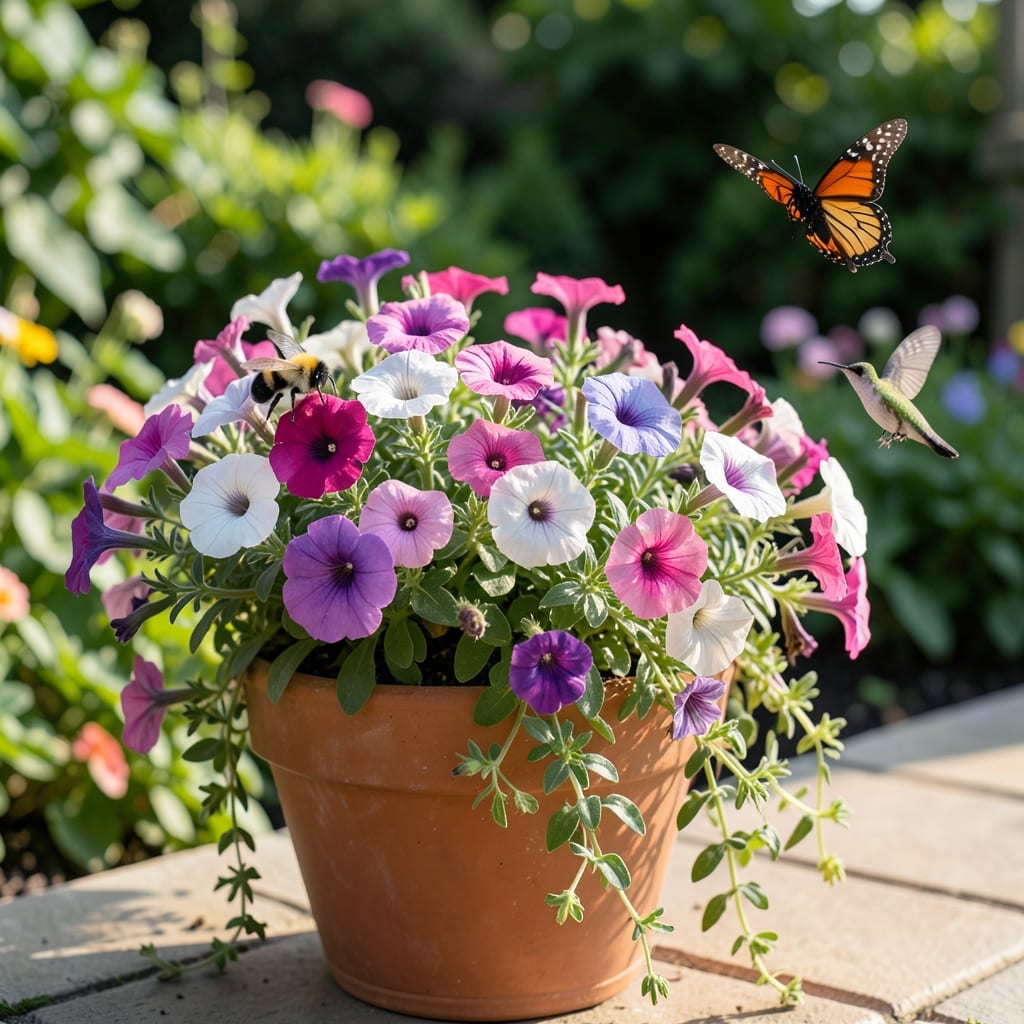
Petunias are not pollinators themselves but attract bees, butterflies, and hummingbirds with their bright colors and nectar, aiding garden pollination.
I love how these vibrant flowers act like nature’s welcome sign for beneficial insects and birds. Their trumpet shape makes it easy for hummingbirds to access nectar, while the bright hues guide bees from afar. This symbiotic relationship boosts biodiversity in any garden space. 🌟
What’s fascinating is that single-bloom varieties often outperform doubles for attracting pollinators, as their open centers provide better access to nectar. ✨
💡 In This Article
Petunias use a clever combination of visual and chemical signals to attract pollinators. Their bright colors—especially blues, purples, and pinks—are highly visible to bees, which see ultraviolet light patterns on the petals that humans can’t. This acts like a neon sign directing them to the nectar. 🔥
The trumpet-shaped flowers produce nectar at concentrations of 15-30% sugar, which provides the high-energy fuel pollinators need. Hummingbirds, in particular, favor these tubular blooms because their long beaks and tongues can easily reach the nectar at the base. The flower’s structure even guides them to brush against pollen as they feed.
Scent plays a subtle but important role too. While petunias aren’t as fragrant as some flowers, they emit volatile compounds that bees and butterflies can detect from 50-100 feet away. These scents become more pronounced on warm, sunny days when pollinator activity peaks. ✨
What’s especially effective is how petunias produce nectar continuously throughout the day. Unlike some flowers that only secrete nectar at specific times, petunias maintain a steady supply. This reliability makes them a preferred food source for bees working long hours in the garden.
For gardeners, this means petunias create what ecologists call a “pollinator hotspot.” A single clump of 10-12 plants can support dozens of bee visits per hour during peak bloom, dramatically improving pollination rates for nearby vegetables and fruits. 🌟
No, petunias don’t require pollinators to grow or bloom. They self-pollinate easily and will produce flowers without insect assistance. However, pollinator visits can increase seed production for propagation.
Bees, butterflies, and hummingbirds are the primary visitors. Bees love the 15-30% sugar nectar, while hummingbirds prefer the tubular shapes. Butterflies are drawn to the flat landing surfaces of single-bloom varieties.
Double blooms have extra petals that block access to nectar and pollen. Pollinators can’t reach the rewards, so they avoid these varieties. Single blooms with open centers are far more effective for attracting visitors.
A cluster of 10-12 petunias can create a pollinator hotspot. The increased bee activity will boost pollination rates for tomatoes, peppers, and other garden crops within 50-100 feet.