
Beautiful Plants For Your Interior
Beautiful Plants For Your Interior
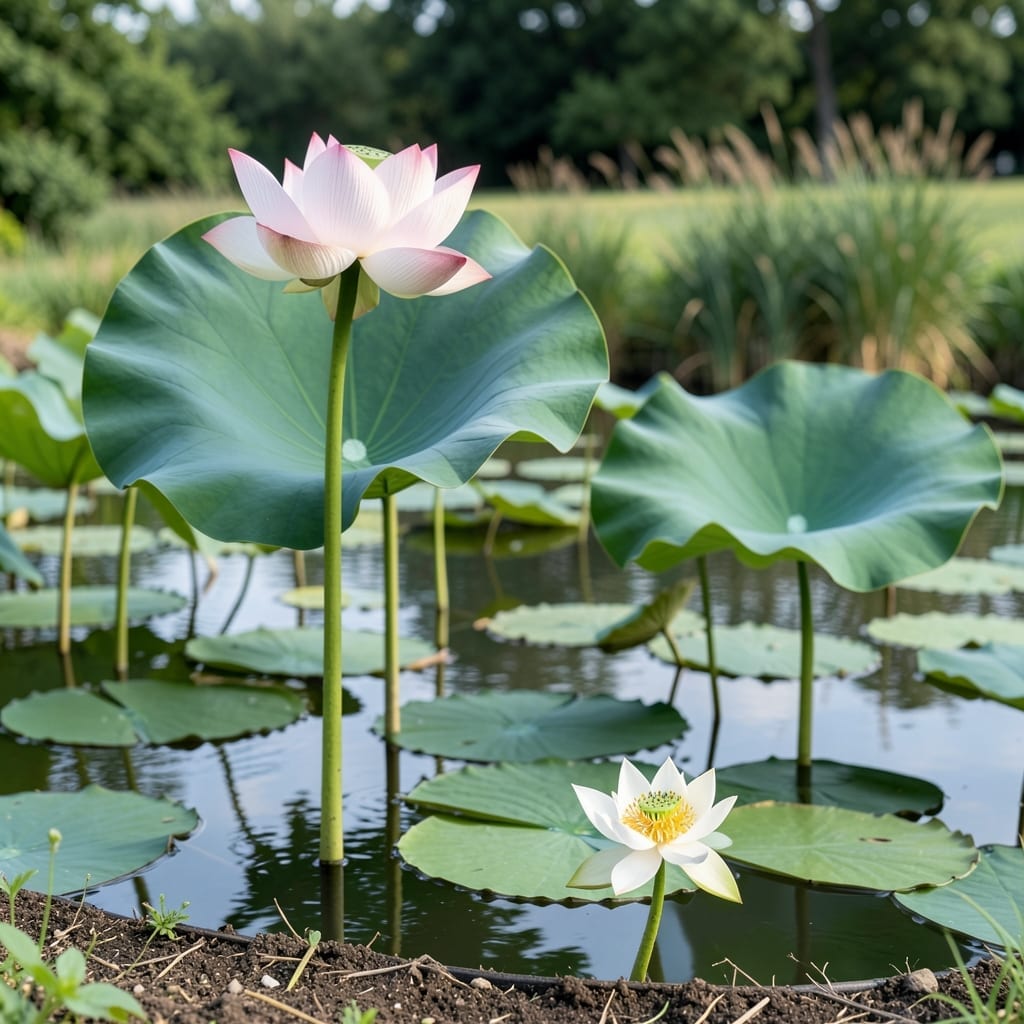
No, they are distinct aquatic plants. Lotus flowers have tall stems with leaves and blooms rising above water, while water lilies float on the surface with roots anchored in mud.
I find their differences fascinating when observing ponds. Lotuses belong to the Nelumbonaceae family, while water lilies are part of Nymphaeaceae, which explains their unique growth patterns. The lotus stands majestically above water, whereas water lilies spread gracefully across the surface. 🌿
Their leaves tell another story—lotus leaves are waxy and elevated, while water lily pads lie flat, creating that classic floating look we all recognize.
💡 In This Article
These plants belong to entirely different botanical families, which explains their distinct characteristics. Lotuses are part of Nelumbonaceae, a family with only one genus, while water lilies fall under Nymphaeaceae, which contains about 70 species. This fundamental difference creates unique evolutionary paths and adaptations.
The lotus grows from rhizomes buried deep in mud, sending up tall stems that can reach 3-6 feet above water. Its leaves are large, circular, and waxy, with a characteristic umbrella shape that sheds water.
Water lilies, however, have rhizomes that spread horizontally just beneath the surface, with leaves that float directly on the water’s surface.
Flower structure offers another clear distinction. Lotus blooms appear singularly on tall stalks, with petals arranged in a spiral pattern. Water lily flowers, typically 3-12 inches across, float on or just above the water, with petals radiating from the center.
The lotus flower also has a unique central seed pod that resembles a shower head when mature. ✨
Their seasonal behavior differs significantly too. Lotuses are tropical plants that thrive in warm climates, with some varieties able to survive brief freezing periods. Water lilies are more cold-hardy, with many species capable of overwintering in frozen ponds. This adaptability makes water lilies more common in temperate garden ponds.
Perhaps most strikingly, lotus seeds can remain dormant for thousands of years and still germinate, a phenomenon called “living fossil” status. Water lily seeds, while long-lived, typically remain viable for just 10-20 years. This incredible longevity is one of the lotus’s most fascinating biological adaptations. 🌟
No, lotus flowers are in the Nelumbonaceae family, while water lilies belong to Nymphaeaceae. This fundamental difference explains their unique growth patterns and appearances.
Look for height first—lotus stems rise 3-6 feet above water, while water lily pads float on the surface. Lotus leaves are waxy and elevated, while water lily pads are flat and round.
No, lotus blooms stand tall on separate stalks with spiral petals, while water lily flowers float or hover just above the surface with radiating petals. The lotus also has a unique central seed pod.
Water lilies are more cold-hardy and can survive freezing temperatures, making them more common in garden ponds across different climates. Lotuses prefer warmer water.