
Beautiful Plants For Your Interior
Beautiful Plants For Your Interior
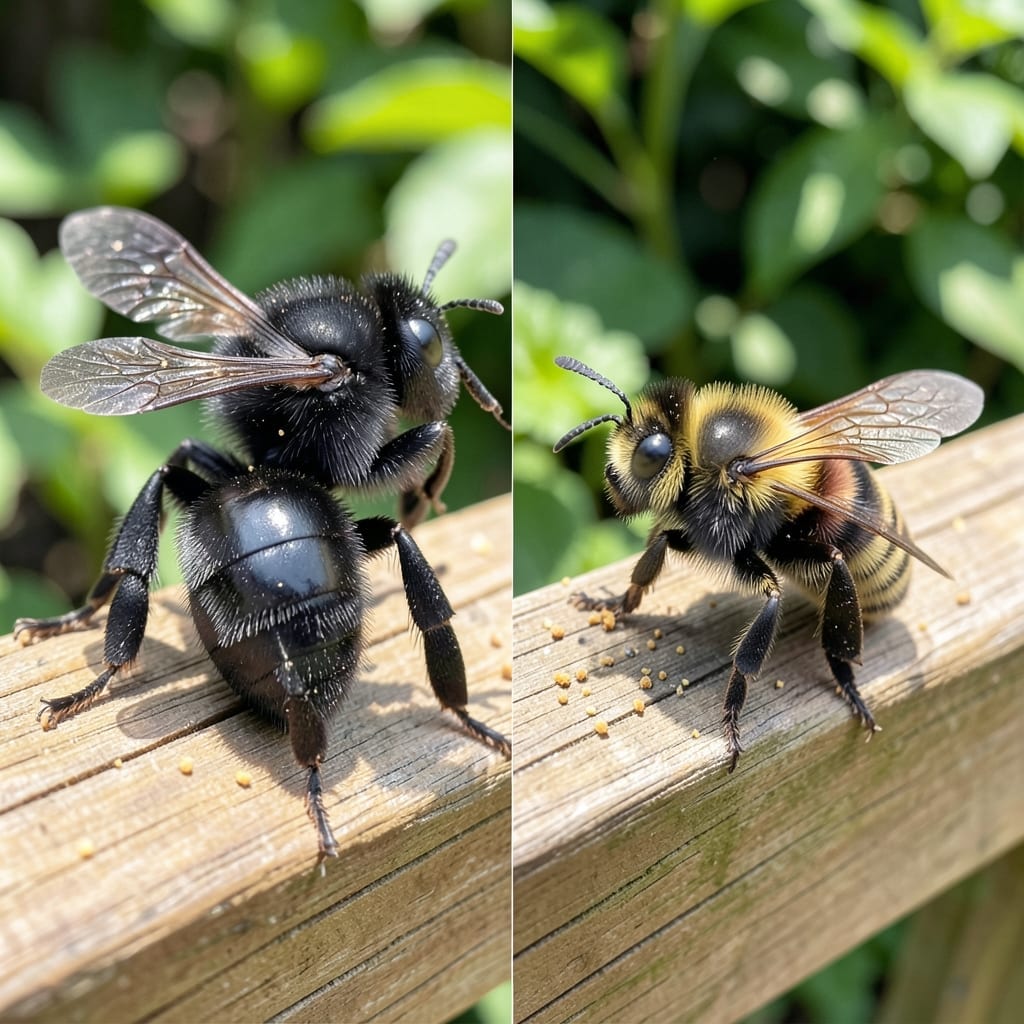
Yes, carpenter bees are generally larger than bumblebees, with females reaching up to 1 inch long, while bumblebees typically max out around 0.75 inches.
I notice the size difference most when observing their flight patterns—carpenter bees have a more robust, heavy appearance in the air. Their shiny, hairless abdomens also make them look sleeker compared to the fuzzy bumblebee build. 🔥
What’s fascinating is how their size affects behavior. Larger carpenter bees can drill deeper into wood, while smaller bumblebees focus more on pollinating flowers.
💡 In This Article
The size difference stems from their distinct evolutionary roles. Carpenter bees have developed larger bodies to excavate wood for nesting, requiring powerful mandibles and robust musculature. Their abdomen appears shiny and bare, lacking the dense fuzzy coating of bumblebees, which helps them navigate tight tunnels more efficiently. 🔥
Bumblebees, on the other hand, are built for agility and pollen collection. Their rounder, more compact bodies allow for rapid flower-to-flower movement, with fuzzy coats that help pollen stick to them. A bumblebee’s wings beat at 200 times per second, enabling their characteristic buzzing sound and hover capability.
This design prioritizes pollen transport over structural excavation.
Color patterns offer another clear distinction. Carpenter bees often display metallic blue, green, or purple hues on their bodies, while bumblebees feature the classic black and yellow striped pattern. The carpenter bee’s shiny abdomen is a dead giveaway—bumblebees are uniformly fuzzy all over. These visual cues make identification straightforward even from a distance. ✨
Wing appearance differs significantly too. Carpenter bees have longer wings relative to their body size, appearing almost translucent in flight. Bumblebees possess shorter, faster-moving wings that create their distinctive buzz. This wing structure supports their different flight patterns: carpenter bees in straight, purposeful lines; bumblebees in quick, erratic movements.
Seasonal variations can affect perceived size. Carpenter bees emerge earlier in spring when they’re most active, while bumblebee colonies grow throughout summer, with workers appearing progressively smaller than their queen. A queen bumblebee can reach 0.9 inches, nearly matching female carpenter bees, but worker bumblebees are noticeably smaller. 💫
Carpenter bees have smooth, hairless abdomens that reflect light, giving them a metallic sheen. Bumblebees are covered in dense fuzz all over, which scatters light instead. This difference helps with identification from a distance.
Yes, male carpenter bees are slightly smaller than females, typically measuring 0.7-0.9 inches. Females need the extra size for drilling and carrying pollen. Males also lack the stinger, making them harmless despite their aggressive appearance.
Carpenter bees are the culprits. Their larger size allows them to chew 1/2-inch wide tunnels into untreated wood. Bumblebees don’t bore into wood at all—they prefer nesting in the ground or grassy areas.
Carpenter bees produce a deep, steady hum, while bumblebees create a higher, buzzier sound. The difference comes from their wing size and beat frequency. Listen closely near flowers or wood to spot the distinction.