
Beautiful Plants For Your Interior
Beautiful Plants For Your Interior
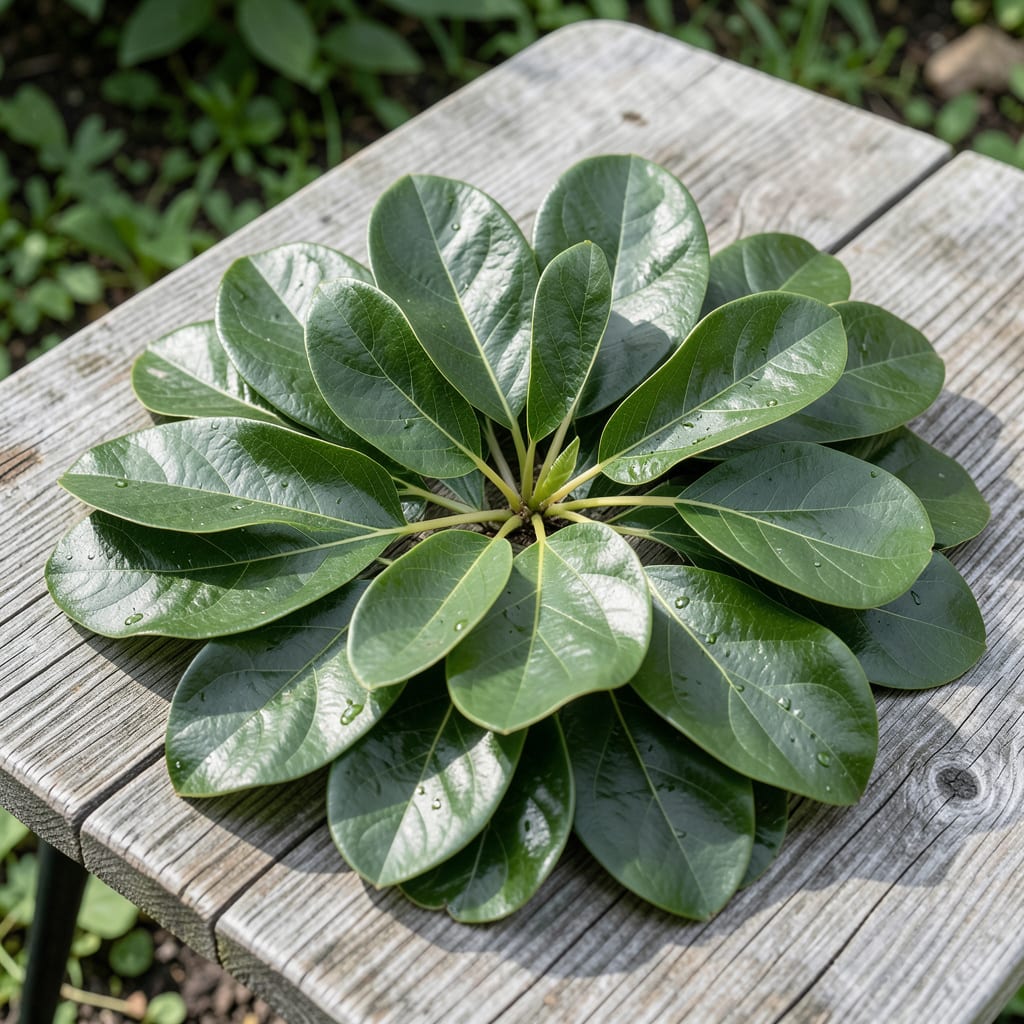
Those glossy, dark green leaves caught my eye immediately in the orchard. Persimmon tree foliage has a unique look that’s hard to miss once you know what to spot.
The leaves are elliptical with smooth edges and a leathery texture, growing 2-6 inches long. They turn a stunning orange-red in fall, making identification even easier when the fruit starts forming.
📚 In This Guide
Use these clear visual markers to distinguish persimmon foliage from look-alike species in your landscape.
Persimmon leaves display a distinct oval to elliptical shape that typically measures 2-6 inches long and 1-3 inches wide. The base of the leaf often appears slightly asymmetrical, with one side slightly wider than the other. This subtle imbalance is a key identifier that sets them apart from more symmetrical leaves.
Hold the leaf up to the light to check its general outline. You’ll notice the tip comes to a gentle point rather than a sharp or rounded end. The edges appear smooth, though they may show very fine serrations that are nearly invisible to the naked eye.
Mature persimmon leaves present a rich dark green on the upper surface with a paler, slightly fuzzy underside. The texture feels smooth and slightly leathery when you run your fingers across the top surface. This is especially noticeable in older leaves.
New growth emerges with a lighter, almost bronze-green hue that gradually darkens as the season progresses. In autumn, the leaves transform dramatically to shades of orange, red, or purple, which is often the most obvious identification feature when other markers aren’t visible.
Examine the venation pattern closely. Persimmon leaves have a pinnate vein structure, meaning one central vein runs down the middle with smaller veins branching off in pairs. These secondary veins curve upward as they approach the leaf’s edge, creating a subtle arching pattern.
The central vein is often slightly raised on the underside, giving it a slightly ridged feel. Between 5-8 pairs of secondary veins branch off from the midrib, with the spacing between them becoming wider as they move toward the leaf tip.
Persimmon leaves grow in an alternate arrangement along the branches, meaning they emerge singly at different heights rather than in pairs or clusters. This creates a staggered, zig-zag pattern along the stem when viewed from the side.
Each leaf attaches to the stem with a short petiole that measures about ½ to 1 inch long. The base of the leaf often slightly wraps around the stem, which can be particularly noticeable when leaves are densely packed on new growth.
In spring, watch for the combination of new leaf growth alongside developing fruit. Persimmon trees often produce their distinctive orange, tomato-like fruits that hang from the branches like ornaments. The fruits typically appear after the leaves have fully developed.
As the growing season progresses, the leaves maintain their shape but may develop slight curling at the edges during periods of drought. This curling, combined with the fruit presence, creates an unmistakable identification profile that’s hard to confuse with other trees.
Here’s how to avoid common mistakes when identifying these leaves in your garden.
The Shape Factor: Pay close attention to the oval to elliptical shape measuring 2-6 inches long and 1-3 inches wide. The slight asymmetry at the base is subtle but crucial—it sets persimmon leaves apart from more uniform leaves.
Color Clues: Mature leaves are dark green on top with a paler, fuzzy underside. In autumn, they turn vibrant shades of orange, red, or purple, which can be a dead giveaway if other markers aren’t obvious.
Vein Pattern Insight: The pinnate vein structure, with 5-8 pairs of secondary veins curving upward, is a telltale sign. The central vein’s raised ridge on the underside is another detail that’s easy to overlook but helps confirm identification.
Persimmon leaves are glossy, dark green, and oval-shaped with smooth edges. They turn vibrant orange-red in fall. Look for a pointed tip and a slightly leathery texture to confirm.
Spring and summer are ideal for observing the deep green, glossy leaves. Fall is perfect for spotting their distinctive orange-red hues, making identification easier.
Yes! Black gum and sweet gum leaves can resemble persimmon leaves. Check for the persimmon’s smoother edges and lack of serrations to differentiate.
Double-check the tree’s fruit or bark—persimmons have unique blocky bark. If unsure, compare with a known persimmon tree or consult a local arborist.
